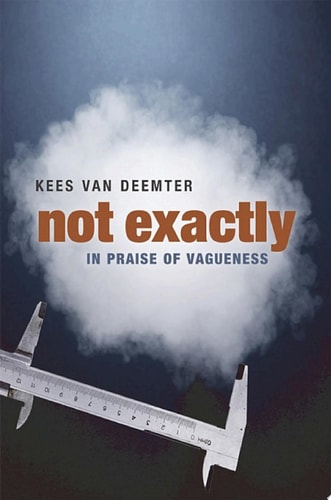
Not Exactly: In Praise of Vagueness
0
0
As an Amazon Associate and affiliate partner, Menrva Books earns from qualifying purchases. Learn more
Author Description
Not everything is black and white. Our daily lives are full of vagueness or fuzziness. Language is the most obvious example - for instance, when we describe someone as tall, it is as though there is a particular height beyond which a person can be considered 'tall'. Likewise the terms 'blond' or 'overweight' in common usage. We often think in discontinuous categories when we are considering something continuous. In this book, van Deemter cuts across various disciplines in considering the nature and importance of vagueness. He looks at the principles of measurement, and how we choose categories; the vagueness lurking behind what seems at first sight crisp concepts such as that of the biological 'species'; uncertainties in grammar and the impact of vagueness on the programmes of Chomsky and Montague; vagueness and mathematical logic; computers, vague descriptions, and Natural Language Generation in AI (a new class of programs will allow computers to handle descriptions such as 'the man in the yellow shirt'). Van Deemter shows why vagueness is in various circumstances both unavoidable and useful, and how we are increasingly able to handle fuzziness in mathematical logic and computer science.
Menrva's Summary
THE THESIS
This book investigates the fundamental role of vagueness in human language, logic, and computational systems, arguing that fuzziness is not a defect but an essential feature of communication. Kees van Deemter, a researcher in computer science and linguistics, synthesizes insights from philosophy, biology, and artificial intelligence to demonstrate how humans categorize continuous reality into discrete concepts. He posits that rather than striving for absolute precision, we must understand and model the inherent ambiguity that characterizes our interaction with the world.
THE SCOPE MAP
What You Will Find
- Analysis of linguistic categories like 'tall' or 'blond' and their continuous nature
- Examination of biological classification systems such as the definition of a species
- Discussion of mathematical logic and its limitations in capturing vague concepts
- Applications in Natural Language Generation for AI systems
Scope Limits
- Does not provide a comprehensive history of philosophical skepticism
- Does not offer a practical guide for software engineering implementation
THE AUTHORITY PERSPECTIVE
Experts highlight this work as a bridge between theoretical linguistics and practical computational logic. Readers frequently note the accessible prose style, which manages to explain complex logical concepts without sacrificing academic rigor.
Page Count:
354
Publication Date:
2010-01-01
Publisher:
OUP Oxford
ISBN-10:
0191647853
ISBN-13:
9780191647857
Philosophy
Logic
Logic & Critical Reasoning
Computer Science
Semantics
Linguistics
Comparative linguistics
Computational linguistics
Community Tags
Similar Books