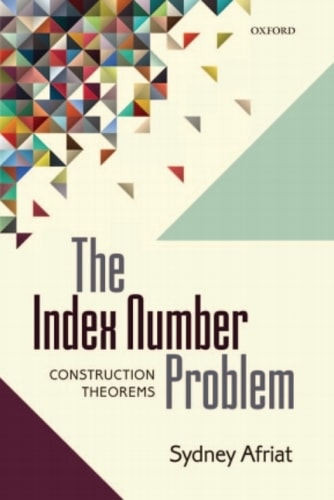
The Index Number Problem: Construction Theorems
0
0
As an Amazon Associate and affiliate partner, Menrva Books earns from qualifying purchases. Learn more
Author Description
A theft amounting to £1 was a capital offence in 1260 and a judge in 1610 affirmed the law could not then be applied since £1 was no longer what it was. Such association of money with a date is well recognized for its importance in very many connections. Thus arises the need to know how to convert an amount at one date into the right amount at another date: in other words, a price index. The longstanding question concerning how such an index should be constructed is known as 'The Index Number Problem'. The ordinary consumer price index represents a practical response to this need. However the search for a true price index has given rise to extensive thought and theory to which an impressive number of economists have each contributed a word, or volume. However, there have been hold-ups at a basic level, which are addressed in this book. The approach brings the subject into involvement with utility construction on the basis of finite data, in a form referred to as 'Afriat's Theorem' but now with utility subject to constant (and also possibly approximate) returns.
Menrva's Summary
THE THESIS
This book investigates the fundamental theoretical and practical challenges involved in constructing accurate price indices to account for the changing value of money over time. Sydney N. Afriat, a noted economist, utilizes his own established framework—known as Afriat's Theorem—to address persistent obstacles in utility construction. By applying finite data sets, the author explores how utility functions can be modeled under conditions of constant and approximate returns to provide a more rigorous basis for index number theory.
THE SCOPE MAP
What You Will Find
- Theoretical foundations of price index construction
- Application of Afriat's Theorem to utility theory
- Analysis of utility functions under constant and approximate returns
- Mathematical modeling using finite data sets
Scope Limits
- Does not provide a general history of global economic policy
- Does not serve as a basic primer for general consumer finance
THE AUTHORITY PERSPECTIVE
Experts recognize this work as a specialized contribution to the mathematical foundations of microeconomics and index theory. Readers frequently note the technical density of the prose, which requires a strong background in economic theory and mathematical analysis to fully comprehend.
Page Count:
240
Publication Date:
2014-01-01
Publisher:
OUP Oxford
ISBN-10:
019164952X
ISBN-13:
9780191649523
Economics
Statistics
Econometrics
Mathematics
Finance
Community Tags
Similar Books