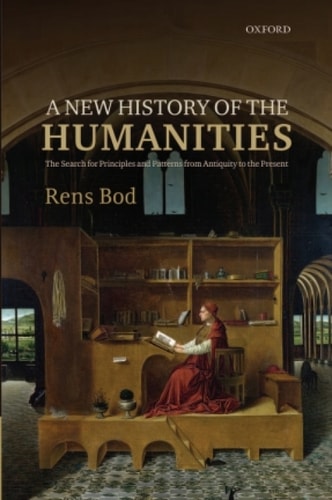
A New History of the Humanities: The Search for Principles and Patterns from Antiquity to the Present
0
0
As an Amazon Associate and affiliate partner, Menrva Books earns from qualifying purchases. Learn more
Author Description
Many histories of science have been written, but A New History of the Humanities offers the first overarching history of the humanities from Antiquity to the present. There are already historical studies of musicology, logic, art history, linguistics, and historiography, but this volume gathers these, and many other humanities disciplines, into a single coherent account. Its central theme is the way in which scholars throughout the ages and in virtually all civilizations have sought to identify patterns in texts, art, music, languages, literature, and the past. What rules can we apply if we wish to determine whether a tale about the past is trustworthy? By what criteria are we to distinguish consonant from dissonant musical intervals? What rules jointly describe all possible grammatical sentences in a language? How can modern digital methods enhance pattern-seeking in the humanities? Rens Bod contends that the hallowed opposition between the sciences (mathematical, experimental, dominated by universal laws) and the humanities (allegedly concerned with unique events and hermeneutic methods) is a mistake born of a myopic failure to appreciate the pattern-seeking that lies at the heart of this inquiry. A New History of the Humanities amounts to a persuasive plea to give Panini, Valla, Bopp, and countless other often overlooked intellectual giants their rightful place next to the likes of Galileo, Newton, and Einstein.
Menrva's Summary
THE THESIS
This book investigates whether the humanities share a common intellectual foundation by tracing the historical search for patterns and principles across diverse disciplines from antiquity to the modern era. Rens Bod, a professor of Digital Humanities and Computational and Humanities, challenges the traditional dichotomy between the sciences and the humanities. He argues that scholars in fields such as linguistics, musicology, and historiography have historically utilized systematic, pattern-seeking methodologies comparable to those found in the natural sciences. By synthesizing centuries of intellectual development, the author posits that the humanities possess a rigorous, rule-based history that has been largely overlooked in favor of scientific narratives.
THE SCOPE MAP
What You Will Find
- A comprehensive chronological survey of humanities disciplines including linguistics, musicology, art history, and historiography.
- An analysis of cross-cultural intellectual traditions, including non-Western contributions from figures like Panini.
- A critical examination of the historical evolution of hermeneutic and analytical methods.
Scope Limits
- The text does not provide an exhaustive biography of every individual scholar mentioned.
- It does not focus on the sociological or political impacts of these disciplines, prioritizing the history of ideas and methodology instead.
THE AUTHORITY PERSPECTIVE
Scholars and critics frequently note the impressive breadth of the research and the author's success in unifying disparate fields under a single analytical framework. Experts highlight this as a significant contribution to intellectual history that effectively challenges the perceived divide between the sciences and the humanities.
Page Count:
400
Publication Date:
2013-01-01
Publisher:
OUP Oxford
ISBN-10:
0191642940
ISBN-13:
9780191642944
History
Philosophy
Intellectual History
World Civilization
Humanities
Academic
Community Tags
Similar Books