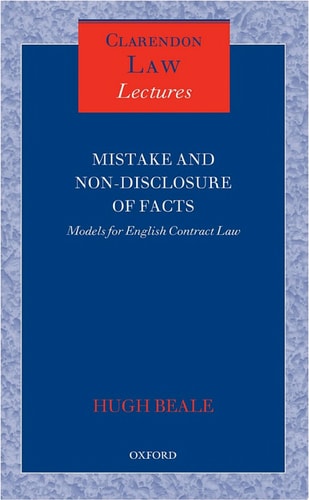
Mistake and Non-Disclosure of Fact: Models for English Contract Law
0
0
As an Amazon Associate and affiliate partner, Menrva Books earns from qualifying purchases. Learn more
Author Description
In this book Hugh Beale examines the case for reforming the law on mistake and non-disclosure of fact to bring English law closer to the law in much of continental Europe. There, and in common law countries like the US, a party may avoid a contract for mistake of fact on a more liberal basis, and a party who deliberately keeps silent knowing that the other party is making a mistake may be guilty of fraud. This is not necessarily the case in England and Wales. Developing a proposal for law reform, the author concedes that the English courts require a law that puts great emphasis on certainty and expects parties to look out for their own interests; but posits that this individualistic approach is not suitable for smaller businesses which are less sophisticated and which are likely to be making low value contracts, so that relative cost of taking advice will be high. He argues that the solution may not be to reform English contract law generally, but to support the development of an optional instrument on contract law, along the lines of the Common European Sales Law recently proposed by the European Commission. This measure is aimed specifically at the needs of small and medium enterprises, and contains the protective rules found in the other jurisdictions. It is aimed primarily at cross-border sales, but Member States would be given the option of adopting it for domestic transactions too. This would give small businesses the choice of using the current "hard-nosed" law or adopting the more protective optional instrument, recognizing that different parties require different things from the law governing their contract.
Menrva's Summary
THE THESIS
This book investigates whether English contract law regarding mistake and non-disclosure requires reform to better accommodate the needs of small and medium-sized enterprises. Hugh Beale, a prominent legal scholar, utilizes a comparative analysis of English law against continental European and United States legal frameworks. He argues that while the English emphasis on certainty and self-reliance serves sophisticated parties, it creates significant disadvantages for smaller businesses. The author proposes the adoption of an optional instrument, similar to the Common European Sales Law, to provide a more protective alternative for domestic and cross-border transactions.
THE SCOPE MAP
What You Will Find
- Comparative analysis of English, continental European, and United States contract law doctrines.
- Evaluation of the 'hard-nosed' individualistic approach in English courts.
- Proposed framework for an optional instrument to supplement existing contract law.
Scope Limits
- The text does not provide a comprehensive history of all contract law doctrines.
- It does not offer a definitive legislative draft but rather a conceptual proposal for reform.
THE AUTHORITY PERSPECTIVE
Legal scholars and practitioners view this work as a significant contribution to the debate on the modernization of English contract law. Readers frequently note the academic density of the prose, which is intended for an audience familiar with comparative jurisprudence and commercial legal theory.
Page Count:
171
Publication Date:
2012-01-01
Publisher:
OUP Oxford
ISBN-10:
019164191X
ISBN-13:
9780191641916
Professional Career & Trade
European Law
Law
Business Law
Contract law
Legal Theory
Community Tags
Similar Books