
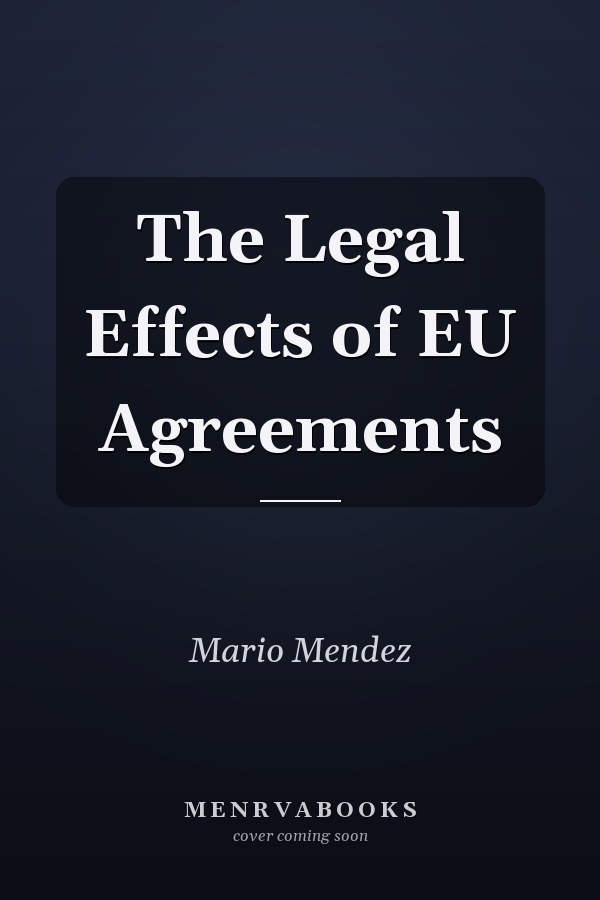
The Legal Effects of EU Agreements
0
0
As an Amazon Associate and affiliate partner, Menrva Books earns from qualifying purchases. Learn more
Author Description
This is an open access title available under the terms of a CC BY-NC-ND 3.0 International licence. It is free to read at Oxford Scholarship Online and offered as a free PDF download from OUP and selected open access locations. Comprehensively examining the legal effects of EU concluded treaties, this book provides a thorough analysis of this increasingly important and rapidly growing area of EU law. The EU has concluded more than 1000 treaties including recently its first human rights treaty (the UN Rights of Persons with Disability Convention). These agreements are regularly invoked in litigation in the Courts of the member states and before the EU courts in Luxembourg but their ramifications for the EU legal order and that of the member states remains underexplored. Through analysis of over 300 cases, the author finds evidence of a twin-track approach whereby the Court of Justice of the European Union (CJEU) adopts a maximalist approach to Treaty enforcement where EU agreements are invoked in challenges to member state level action whilst largely insulating EU action from meaningful review vis-à-vis agreements. The book also reveals novel findings regarding the use of EU agreements in EU level litigation including: the types and which specific EU agreements (including the types of provisions) have arisen in litigation; the nature of the proceedings (preliminary rulings or direct actions) and the number of occasions in which they have been addressed in challenges to member state or EU action and the outcomes; who has been litigating (individuals, institutions, or member states) and which domestic courts have been referring questions to the CJEU. The significance of the judicial developments in this area are situated within the context of the domestic constitutional ramifications for member state legal orders thus revealing a neglected dimension in the constitutionalization debates which traditionally emphasized the ramifications of internal EU law for the domestic
Menrva's Summary
THE THESIS
This book investigates the legal effects of treaties concluded by the European Union and the resulting implications for the EU legal order and member state constitutional frameworks. Mario Mendez, a legal scholar, utilizes an extensive dataset of over 300 judicial cases to evaluate how the Court of Justice of the European Union (CJEU) interprets and enforces international agreements. The author argues that the CJEU employs a twin-track approach, favoring maximalist enforcement against member state actions while simultaneously insulating EU-level actions from similar scrutiny.
THE SCOPE MAP
What You Will Find
- Analysis of over 1000 EU-concluded treaties including human rights conventions.
- Empirical data derived from 300+ court cases involving EU agreements.
- Examination of litigation patterns, including the identity of litigants and the frequency of preliminary rulings versus direct actions.
- Discussion of the constitutional ramifications for domestic legal systems within member states.
Scope Limits
- The analysis focuses primarily on judicial interpretation and does not provide a comprehensive legislative history of every treaty mentioned.
- The text is limited to the legal framework of the EU and does not extend to a comparative analysis of non-EU international legal systems.
THE AUTHORITY PERSPECTIVE
Legal scholars and practitioners identify this work as a foundational text for understanding the intersection of international treaty law and the EU legal order. Readers frequently note the academic density of the prose and the rigorous empirical methodology applied to the analysis of CJEU case law.
Page Count:
396
Publication Date:
2013-01-01
Publisher:
OUP Oxford
ISBN-10:
019164837X
ISBN-13:
9780191648373
International Law
Professional Career & Trade
Law
Constitutional Law
European Union
Academic
Community Tags
Other Editions(3)

Similar Books











Reader Comments
Share Your Thoughts
No comments yet. Be the first to share your thoughts!