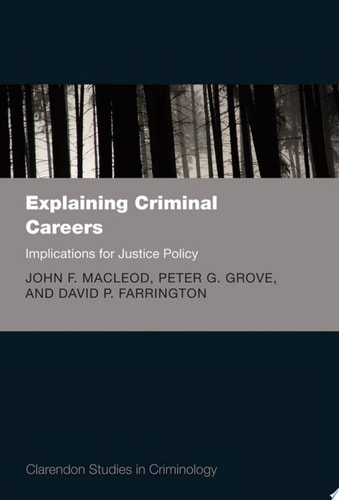
Explaining Criminal Careers
0
0
As an Amazon Associate and affiliate partner, Menrva Books earns from qualifying purchases. Learn more
Author Description
This Is An Open Access Title Available Under The Terms Of A Cc By-nc-nd 3.0 International Licence. It Is Free To Read At Oxford Scholarship Online And Offered As A Free Pdf Download From Oup And Selected Open Access Locations. Explaining Criminal Careers Presents A Simple But Influential Theory Of Crime, Conviction And Reconviction. The Assumptions Of The Theory Are Derived Directly From A Detailed Analysis Of Cohort Samples Extracted From The Home Office Offenders Index - A Unique Database Which Contains Records Of All Criminal (standard List) Convictions In England And Wales Since 1963. In Particular, The Theory Explains The Well-known Age/crime Curve. Based On The Idea That There Are Only Three Types Of Offenders, Who Commit Crimes At Either High Or Low (constant) Rates And Have Either A High Or Low (constant) Risk Of Reoffending, This Simple Theory Makes Exact Quantitative Predictions About Criminal Careers And Age-crime Curves. Purely From The Birth-rate Over The Second Part Of The 20th Century, The Theory Accurately Predicts (to Within 2%) The Prison Population Contingent On A Given Sentencing Policy. The Theory Also Suggests That Increasing The Probability Of Conviction After Each Offence Is The Most Effective Way Of Reducing Crime, Although There Is A Role For Treatment Programmes For Some Offenders. The Authors Indicate That Crime Is Influenced By The Operation Of The Criminal Justice System And That Offenders Do Not 'grow Out' Of Crime As Commonly Supposed; They Are Persuaded To Stop Or Decide To Stop After (repeated) Convictions, With A Certain Fraction Of Offenders Desisting After Each Conviction. Simply Imprisoning Offenders Will Not Reduce Crime Either By Individual Deterrence Or By Incapacitation. With Comprehensive Explanations Of The Formulae Used And Complete Mathematical Appendices Allowing For Individual Interpretations And Further Development Of The Theory, Explaining Criminal Careers Represents An Innovative And Meticulous Investigation Into Cr
Menrva's Summary
THE THESIS
This book investigates the underlying mechanisms of criminal careers to explain patterns of conviction and reconviction through a quantitative theoretical framework. The authors, led by David P. Farrington, utilize longitudinal data from the Home Office Offenders Index to challenge conventional wisdom regarding the age-crime curve. By categorizing offenders based on crime rates and recidivism risk, the text provides a mathematical model that predicts prison populations and evaluates the efficacy of various sentencing policies.
THE SCOPE MAP
What You Will Find
- Analysis of cohort samples from the Home Office Offenders Index covering England and Wales since 1963.
- A three-type offender classification system based on crime frequency and reoffending risk.
- Mathematical formulae and appendices for calculating criminal career trajectories and age-crime curves.
- Evaluation of the impact of conviction probability versus imprisonment on crime reduction.
Scope Limits
- The study focuses primarily on standard list convictions within the English and Welsh legal systems.
- The model does not account for unreported crimes or non-convicted criminal activity.
THE AUTHORITY PERSPECTIVE
Experts recognize this work as a significant contribution to quantitative criminology due to its rigorous application of longitudinal data. Readers frequently note the technical density of the mathematical appendices, which serve as a resource for researchers seeking to apply or test the authors' predictive model.
Page Count:
272
Publication Date:
2012-01-01
Publisher:
Oxford University Press
ISBN-10:
0191645249
ISBN-13:
9780191645242
Sociology
Statistics
Criminology
Social Science
Community Tags
Similar Books












Reader Comments
Share Your Thoughts
No comments yet. Be the first to share your thoughts!