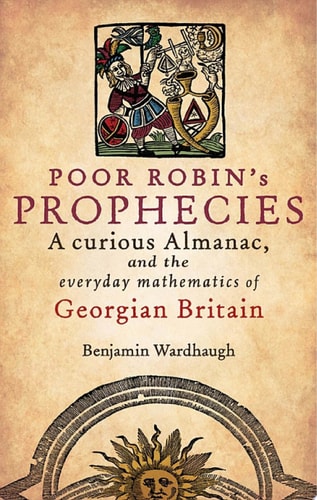
Poor Robin's Prophecies: A Curious Almanac, and the Everyday Mathematics of Georgian Britain
0
0
As an Amazon Associate and affiliate partner, Menrva Books earns from qualifying purchases. Learn more
Author Description
Author, astrologer, journalist, satirist, and 'well-willer to the mathematics', Poor Robin of Saffron Walden was a fantastic, yet invented, figure of British popular culture from the Restoration to the end of the Georgian period. Poor Robin's Almanac first appeared in 1662, developing an enthusiastic following and long outliving its original creator to last until 1828. Benjamin Wardhaugh tells the great story of Georgian popular mathematics - through Poor Robin's remarkable life, from his humble beginnings as an almanac-writer through to best-selling stardom, controversy, and decline. Using the character, wit, and columns of Poor Robin, Wardhaugh explores the mathematics of ordinary people, from learning sums to using mathematics in weighing and measuring, in business, agriculture, map-making, and navigation. This is a history of mathematics that is rarely thought about — creative, popular, and led by practical and social needs. It is centered on the ordinary people that used it. Their names remain little-known; their solutions have vanished along with the situations that required them; but their energy and ideas - as captured by Poor Robin - create a wonderfully rich picture of what mathematics can be, and has been.
Menrva's Summary
THE THESIS
How did the fictional persona of Poor Robin serve as a vehicle for the dissemination and application of mathematics among ordinary people in Georgian Britain? Benjamin Wardhaugh, a historian of mathematics, utilizes the long-running Poor Robin's Almanac to examine the intersection of popular culture and practical numeracy. He argues that mathematics was not merely an academic pursuit but a social necessity integrated into the daily lives, labor, and commerce of the Georgian populace.
THE SCOPE MAP
What You Will Find
- Analysis of the Poor Robin's Almanac publication history from 1662 to 1828
- Examination of mathematical applications in agriculture, navigation, and trade
- Exploration of the role of satire and wit in popularizing technical knowledge
- Contextualization of Georgian-era numeracy within the broader social landscape
Scope Limits
- Does not provide a comprehensive history of professional or academic mathematics
- Does not focus on the lives of elite mathematicians or theoretical breakthroughs
THE AUTHORITY PERSPECTIVE
Scholars and readers frequently note the accessibility of Wardhaugh's prose, which successfully bridges the gap between technical history and social narrative. Experts highlight this work as a valuable contribution to the study of how mathematical literacy functioned in the public sphere before the modern era.
Page Count:
257
Publication Date:
2012-01-01
Publisher:
OUP Oxford
ISBN-10:
0191644579
ISBN-13:
9780191644573
History
Popular Science
Social History
English & College Success
Mathematics
Cultural History
Community Tags
Similar Books