In All Likelihood
0
0
As an Amazon Associate and affiliate partner, Menrva Books earns from qualifying purchases. Learn more
Author Description
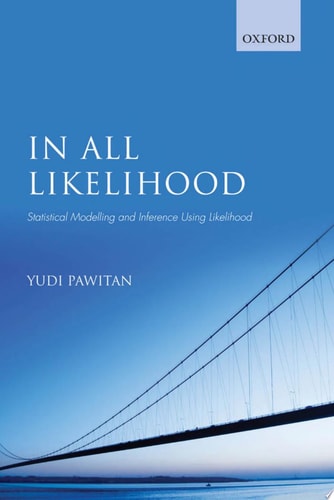
Based On A Course In The Theory Of Statistics This Text Concentrates On What Can Be Achieved Using The Likelihood/fisherian Method Of Taking Account Of Uncertainty When Studying A Statistical Problem. It Takes The Concept Ot The Likelihood As Providing The Best Methods For Unifying The Demands Of Statistical Modelling And The Theory Of Inference. Every Likelihood Concept Is Illustrated By Realistic Examples, Which Are Not Compromised By Computational Problems. Examples Range From A Simile Comparison Of Two Accident Rates, To Complex Studies That Require Generalised Linear Or Semiparametric Modelling. The Emphasis Is That The Likelihood Is Not Simply A Device To Produce An Estimate, But An Important Tool For Modelling. The Book Generally Takes An Informal Approach, Where Most Important Results Are Established Using Heuristic Arguments And Motivated With Realistic Examples. With The Currently Available Computing Power, Examples Are Not Contrived To Allow A Closed Analytical Solution, And The Book Can Concentrate On The Statistical Aspects Of The Data Modelling. In Addition To Classical Likelihood Theory, The Book Covers Many Modern Topics Such As Generalized Linear Models And Mixed Models, Non Parametric Smoothing, Robustness, The Em Algorithm And Empirical Likelihood.
Menrva's Summary
THE THESIS
This text investigates the efficacy of the likelihood-based Fisherian method as a unified framework for statistical modeling and inference. Author Yudi Pawitan presents a pedagogical approach that prioritizes the conceptual utility of likelihood over purely analytical or computational constraints. By leveraging modern computing power, the book demonstrates how likelihood serves as a robust tool for addressing uncertainty across a spectrum of statistical problems, from simple rate comparisons to complex semiparametric models.
THE SCOPE MAP
What You Will Find
- Generalized linear models and mixed models
- Non-parametric smoothing and robustness techniques
- The EM algorithm and empirical likelihood
- Heuristic arguments for statistical results
Scope Limits
- Does not focus on purely theoretical or closed-form analytical derivations
- Excludes basic introductory probability theory for absolute beginners
THE AUTHORITY PERSPECTIVE
Experts and practitioners frequently cite this work for its pragmatic balance between theoretical rigor and applied modeling techniques. Readers often note that the informal, example-driven prose makes complex statistical concepts accessible to those with a foundational understanding of the field.
Page Count:
544
Publication Date:
2001-01-01
Publisher:
Oxford University Press
ISBN-10:
0191650579
ISBN-13:
9780191650574
Probability Theory
Probabilities
Mathematics
Academic Textbooks
Statistics
Data Science
Community Tags
Similar Books