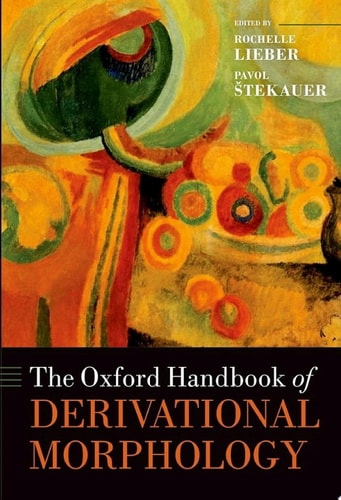
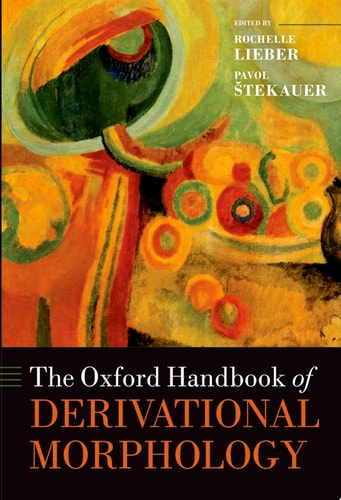
The Oxford Handbook of Derivational Morphology
0
0
As an Amazon Associate and affiliate partner, Menrva Books earns from qualifying purchases. Learn more
Author Description
The Oxford Handbook of Derivational Morphology is intended as a companion volume to The Oxford Handbook of Compounding (OUP 2009) Written by distinguished scholars, its 41 chapters aim to provide a comprehensive and thorough overview of the study of derivational morphology. The handbook begins with an overview and a consideration of definitional matters, distinguishing derivation from inflection on the one hand and compounding on the other. From a formal perspective, the handbook treats affixation (prefixation, suffixation, infixation, circumfixation, etc.), conversion, reduplication, root and pattern and other templatic processes, as well as prosodic and subtractive means of forming new words. From a semantic perspective, it looks at the processes that form various types of adjectives, adverbs, nouns, and verbs, as well as evaluatives and the rarer processes that form function words. The book also surveys derivation in fifteen language families that are widely dispersed in terms of both geographical location and typological characteristics.
Menrva's Summary
THE THESIS
This volume investigates the structural, semantic, and typological mechanisms of derivational morphology across diverse linguistic systems. Edited by Pavol Stekauer and Rochelle Lieber, the text compiles contributions from distinguished scholars to establish a rigorous framework for analyzing how new words are formed. It addresses the fundamental distinctions between derivation, inflection, and compounding to provide a cohesive theoretical foundation for morphological study.
THE SCOPE MAP
What You Will Find
- Formal analysis of affixation, conversion, reduplication, and templatic processes
- Semantic categorization of word-formation for nouns, verbs, adjectives, and adverbs
- Comparative surveys of fifteen distinct language families
Scope Limits
- Does not provide an exhaustive dictionary of all world languages
- Focuses primarily on derivational processes rather than syntactic or phonological theory in isolation
THE AUTHORITY PERSPECTIVE
Experts recognize this volume as a foundational reference for advanced students and researchers in the field of linguistics. Readers frequently note the academic density of the prose and the comprehensive nature of the cross-linguistic data provided.
Page Count:
960
Publication Date:
2014-01-01
Publisher:
OUP Oxford
ISBN-10:
0191651788
ISBN-13:
9780191651786
Reference
Morphology
Academic
English & College Success
English
Linguistics
Community Tags
Other Editions(3)
Similar Books