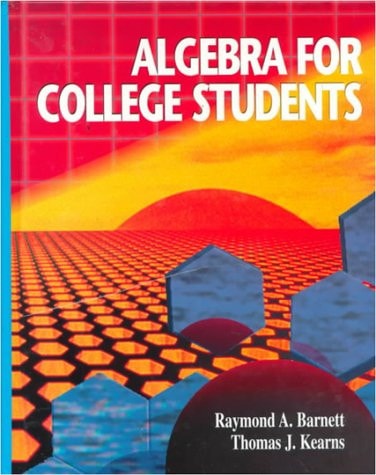
Algebra for College Students
0
0
As an Amazon Associate and affiliate partner, Menrva Books earns from qualifying purchases. Learn more
Author Description
Intended for a course that contains a blend of intermediate and college algebra topics written at an intermediate algebra level, the goal of the text is to provide a sound transition between elementary algebra and more advanced courses in mathematics. It is written for students with differing backgrounds and abilities. An average or below-average student will experience success, and an above-average student will be challenged. The review of elementary algebra topics is covered in Chapter 1, which can be omitted by fully prepared classes. Basic graphing concepts are introduced in Chapter 1, then integrated throughout the text. Function and function notation are introduced in Chapter 3, used in the next two chapters to reinforce ideas, then treated in detail in Chapter 6. This early introduction of functions and graphing allows students to become familiar with, and therefore more comfortable with, concepts that will be critical to their success in future mathematics courses. Student success and anxiety reduction are achieved through a non-threatening, informal writing style and use of numerous pedagogical aids (e.g., examples with "matched problems," annotations, think boxes, chapter summaries, and cumulative reviews.) The text also includes a large quantity and variety of significant and interesting real-world applications.
Menrva's Summary
THE THESIS
This text investigates the foundational algebraic concepts required to bridge the gap between elementary algebra and advanced collegiate mathematics. Author Raymond A. Barnett utilizes a structured pedagogical framework to accommodate students with varying levels of mathematical proficiency. The argument centers on the early introduction of functions and graphing to build long-term conceptual comfort and reduce student anxiety regarding complex mathematical operations.
THE SCOPE MAP
What You Will Find
- Comprehensive review of elementary algebra topics
- Integrated graphing concepts introduced in the initial chapters
- Systematic introduction of function notation and detailed function analysis
- Numerous pedagogical aids including matched problems, annotations, and cumulative reviews
Scope Limits
- The text focuses specifically on intermediate and college algebra levels
- It does not cover advanced calculus or higher-level theoretical mathematics
THE AUTHORITY PERSPECTIVE
Educators frequently utilize this text for its accessible, non-threatening prose style that aims to minimize student apprehension. Experts highlight the inclusion of real-world applications as a primary strength for maintaining student engagement throughout the curriculum.
Page Count:
704
Publication Date:
1994-11-01
Publisher:
McGraw-Hill College
ISBN-10:
0070050015
ISBN-13:
9780070050013
textbook
New Used & Rental Textbooks
College Mathematics
Education
Mathematics
Algebra
Community Tags
Similar Books