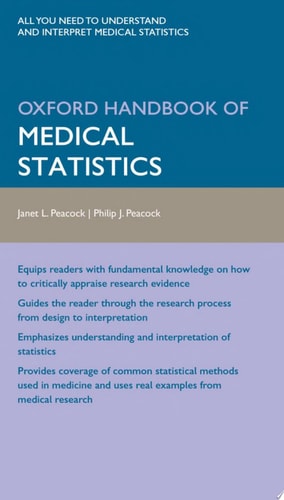
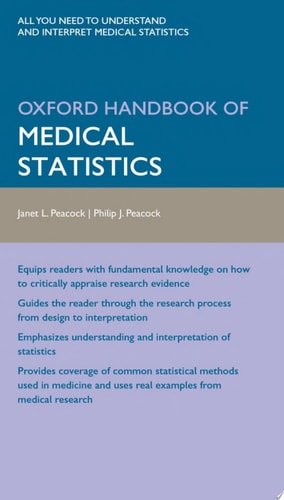
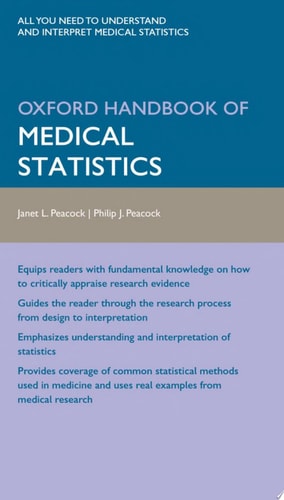
Oxford Handbook of Medical Statistics
0
0
As an Amazon Associate and affiliate partner, Menrva Books earns from qualifying purchases. Learn more
Author Description
To Practice Evidence-based Medicine, Doctors Need To Understand How Research Is Conducted And Be Able To Critically Appraise Research Evidence. A Sound Understanding Of Medical Statistics Is Essential For The Correct Evaluation Of Medical Research And The Appropriate Implementation Of Findings In Clinical Practice. Written In An Easily Accessible Style, The Oxford Handbook Of Medical Statistics Provides Doctors And Medical Students With A Concise And Thorough Account Of This Often Difficult Subject. It Promotes Understanding And Interpretation Of Statistical Methods Across A Wide Range Of Topics, From Study Design And Sample Size Considerations, Through T- And Chi-squared Tests, To Complex Multifactorial Analyses, Using Examples From Published Research. References For Further Reading Are Given For More Information On Specific Topics. Helping Readers To Conduct Their Own Research Or Critically Appraise Other's Work, This Volume Provides All The Information Readers Need To Understand And Interpret Medical Statistics.
Menrva's Summary
THE THESIS
This handbook investigates the core statistical methodologies required for medical professionals to conduct research and critically appraise clinical evidence. Janet Peacock and Philip Peacock provide a structured framework designed to demystify complex quantitative analysis for practitioners and students. By integrating statistical theory with practical clinical examples, the authors aim to bridge the gap between abstract mathematical concepts and their application in evidence-based medicine.
THE SCOPE MAP
What You Will Find
- Comprehensive coverage of study design and sample size determination
- Explanations of statistical tests including T-tests and Chi-squared tests
- Guidance on multifactorial analyses and data interpretation
- References for advanced study on specific statistical topics
Scope Limits
- Does not serve as a substitute for specialized statistical software manuals
- Does not provide exhaustive mathematical proofs for every statistical theorem
THE AUTHORITY PERSPECTIVE
Medical professionals and students frequently cite this volume as a reliable, accessible reference for navigating clinical literature. Experts highlight the text for its ability to distill complex statistical concepts into practical tools for daily clinical practice.
Page Count:
544
Publication Date:
2010-01-01
Publisher:
Oup Oxford
ISBN-10:
019165227X
ISBN-13:
9780191652271
Medical
Evidence Based Medicine
Reference
Clinical Research
Statistics
Academic
Community Tags
Other Editions(4)

Similar Books