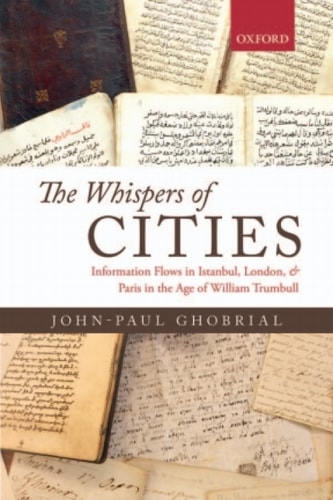
The Whispers of Cities: Information Flows in Istanbul, London, and Paris in the Age of William Trumbull
0
0
As an Amazon Associate and affiliate partner, Menrva Books earns from qualifying purchases. Learn more
Author Description
In recent years, global historians have painted an impressionistic picture of what they call the 'connected world' of the seventeenth century. Inspired perhaps by the globalised world in which they write, scholars have emphasised how the circulation of people, objects, and ideas linked the distant reaches of the early modern world. Yet for all the advocates of such a 'connected history', we are only beginning to make sense of what global connectedness meant in practice in the lives of ordinary people. To this end, The Whispers of Cities explores interactions between early modern Europe and the Ottoman Empire through the kaleidoscope of communication. It does so by focusing on how information flows linked Istanbul, London, and Paris in the late seventeenth century. Because individuals were at the heart of communication, the book offers a micro-historical reading of the experiences of Sir William Trumbull, English ambassador to Istanbul from 1687 to 1692. It follows Trumbull as he was transformed from a civil lawyer and state official in London to a European notable at the heart of Ottoman social networks in Istanbul. In this way, The Whispers of Cities reveals how information flows between Istanbul, London, and Paris were rooted in the personal encounters that took place between Ottomans and Europeans in everyday communication. At the intersection of global history and the history of communication, therefore, the author argues that worlds of information tied Europeans to their Ottoman counterparts long before the age of modernisation, as news, stories, and even fictions transcended linguistic and confessional boundaries and connected people across Europe and the Mediterranean world. What emerges here is a picture of globalization that is as much about networks, flows, and circulation as it is about the imperfections, asymmetries, and unevenness of connectedness in the early modern world.
Menrva's Summary
THE THESIS
This work investigates how information networks and personal communication channels bridged the gap between early modern Europe and the Ottoman Empire during the late seventeenth century. John-Paul A. Ghobrial, a scholar of early modern history, utilizes the diplomatic career of Sir William Trumbull to examine the practical realities of global connectedness. By analyzing Trumbull's transition from a London official to a participant in Ottoman social circles, the author argues that globalization was driven by individual encounters and the circulation of news across linguistic and religious divides.
THE SCOPE MAP
What You Will Find
- Analysis of communication networks linking Istanbul, London, and Paris between 1687 and 1692.
- A micro-historical examination of Sir William Trumbull’s diplomatic correspondence and social interactions.
- Exploration of how news, stories, and rumors transcended cultural boundaries in the Mediterranean world.
Scope Limits
- The study is primarily focused on the specific period of Trumbull's ambassadorship and does not provide a comprehensive history of Ottoman-European relations across the entire century.
THE AUTHORITY PERSPECTIVE
Historians and scholars of early modern studies frequently cite this work for its nuanced approach to microhistory and its ability to ground abstract concepts of globalization in tangible human experience. Experts highlight the text as a significant contribution to the history of communication, noting its effectiveness in demonstrating the asymmetries and imperfections inherent in early modern information flows.
Page Count:
208
Publication Date:
2013-01-01
Publisher:
OUP Oxford
ISBN-10:
0191652652
ISBN-13:
9780191652653
History
Communication History
Global History
European History
Europe
Microhistory
History - Modern
Diplomatic History
Middle East
Community Tags
Similar Books