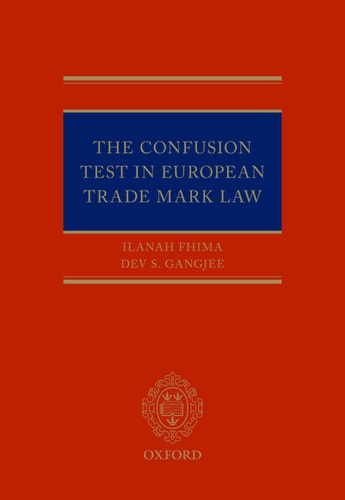
The Confusion Test in European Trade Mark Law
0
0
As an Amazon Associate and affiliate partner, Menrva Books earns from qualifying purchases. Learn more
Author Description
Historically, likelihood of confusion has been the core infringement test for trade mark law, and it remains the most frequently applied test in infringement actions by far. However, there are noticeable differences in how it is applied by the Court of Justice of the European Union (CJEU), the General Court, and national courts; and questionable outcomes when it is applied in novel situations. This book is the first comprehensive and systematic account of the confusion test within the harmonised European trade mark system. It considers how the test is applied by national trade mark registries across EU member states, by the European Union Intellectual Property Office (EUIPO), by national courts, and by the CJEU. It offers practical guidance, while also evaluating the viability of more recent developments such as initial-interest confusion, post-sale confusion and consumer responses to uses of trade marks on the internet. The book analyses three distinct strata of legal doctrine: the decisions of the CJEU, including the General Court; the extensive body of decisions by EUIPO; and the application of harmonised trade mark law by courts of member states, focusing on leading decisions as well as wayward ones. It also draws upon the legal position in the US to illuminate these issues.
Menrva's Summary
THE THESIS
This book investigates the systematic application and inconsistencies of the likelihood of confusion test within the harmonized European trade mark legal framework. The authors, Dev S. Gangjee and Ilanah Simon Fhima, utilize their expertise in intellectual property law to synthesize a vast array of judicial decisions and administrative practices. By examining the interplay between the Court of Justice of the European Union, the European Union Intellectual Property Office, and national courts, the text provides a rigorous analysis of how legal doctrine functions in both established and novel commercial contexts.
THE SCOPE MAP
What You Will Find
- Comparative analysis of trade mark registry practices across EU member states
- Evaluation of modern confusion variants including initial-interest and post-sale confusion
- Examination of judicial decision-making patterns within the CJEU and General Court
- Integration of US legal perspectives for comparative illumination
Scope Limits
- Does not provide an exhaustive catalog of every minor national court ruling
- Focuses primarily on the harmonized European system rather than non-EU international jurisdictions
THE AUTHORITY PERSPECTIVE
Legal scholars and practitioners identify this work as a foundational resource for understanding the complexities of European trade mark infringement. Experts frequently highlight the text for its systematic approach to reconciling disparate judicial interpretations across the European Union.
Page Count:
312
Publication Date:
2019-01-01
Publisher:
OUP Oxford
ISBN-10:
0191656070
ISBN-13:
9780191656071
Intellectual Property
European Law
Law
Professional Career & Trade
Commercial law
Trademarks
Trade Law
Community Tags
Similar Books