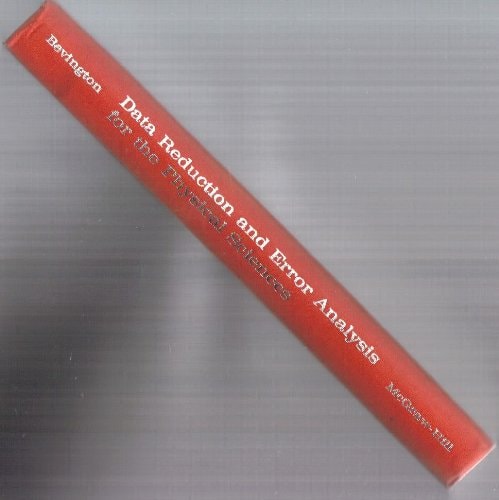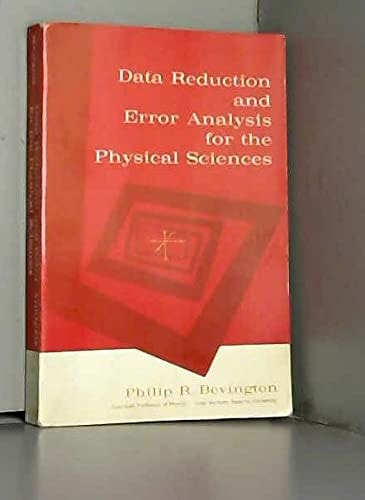
Data Reduction and Error Analysis for the Physical Science
0
0
As an Amazon Associate and affiliate partner, Menrva Books earns from qualifying purchases. Learn more
Author Description
The purpose of this book is to provide an introduction to the concepts of statistical analysis of data for students at the undergraduate and graduate level, and to provide tools for data reduction and error analysis commonly required in the physical sciences. The presentation is developed from a practical point of view, including enough derivation to justify the results, but emphasizing methods of handling data more than theory. This text provides a variety of numerical and graphical techniques. Computer programs that support these techniques will be available on an accompanying website in both Fortran and C++.
Menrva's Summary
THE THESIS
This text investigates the fundamental statistical methods and computational tools required for the rigorous analysis of experimental data in the physical sciences. Author P. R. Bevington provides a structured framework for undergraduate and graduate students to navigate the complexities of data reduction and error propagation. The book balances theoretical derivation with a pragmatic focus on practical application, ensuring that students can apply these techniques directly to laboratory results. By emphasizing methodology over abstract theory, the text serves as a bridge between raw observation and scientific conclusion.
THE SCOPE MAP
What You Will Find
- Statistical distributions and probability theory relevant to physical measurements
- Methods for error propagation and uncertainty estimation
- Least squares fitting and regression analysis techniques
- Numerical and graphical data representation strategies
- Implementation examples in Fortran and C++
Scope Limits
- Advanced theoretical statistics beyond the scope of experimental physical science
- Specific domain-dependent experimental protocols
THE AUTHORITY PERSPECTIVE
Experts and educators frequently cite this work as a foundational text for students entering experimental physics and chemistry. Readers often note the clarity of the prose and the utility of the provided computational examples in modern laboratory settings.
Page Count:
336
Publication Date:
1969-01-01
Publisher:
McGraw-Hill Book Company
ISBN-10:
0070051356
ISBN-13:
9780070051355
Science
Mathematics
Data Analysis
Reference
Physics
New Used & Rental Textbooks
Statistics
Community Tags
Similar Books