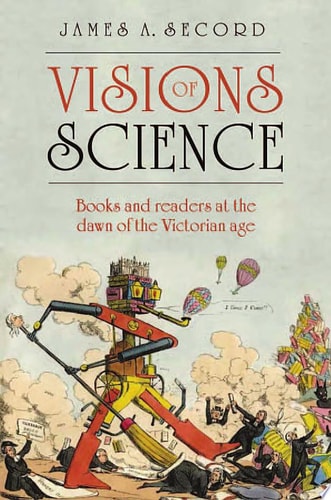
Visions of Science
0
0
As an Amazon Associate and affiliate partner, Menrva Books earns from qualifying purchases. Learn more
Author Description
The Early 1830s Witnessed An Extraordinary Transformation In British Political, Literary, And Intellectual Life. New Scientific Disciplines Begin To Take Shape, While New Concepts Of The Natural World Were Hotly Debated. James Secord, Director Of The Darwin Correspondence Project, Captures This Unique Moment Of Change By Exploring Key Books, Including Charles Lyell's Principles Of Geology, Mary Somerville's Connexion Of The Physical Sciences, And Thomas Carlyle's Satirical Work, Sartor Resartus. Set In The Context Of Electoral Reform And Debates About The Extension Of Education To Meet The Demands Of The Coming Age Of Empire And Industry, Secord Shows How The Books Were Published, Disseminated, Admired, Attacked And Satirized.
Menrva's Summary
THE THESIS
How did the publication and reception of specific scientific texts in the 1830s shape the intellectual and political landscape of Victorian Britain? James A. Secord, director of the Darwin Correspondence Project, utilizes a historical framework to examine the intersection of scientific discourse, electoral reform, and industrial expansion. By analyzing the production and dissemination of seminal works like Lyell's Principles of Geology and Somerville's Connexion of the Physical Sciences, Secord argues that these texts were central to defining the modern natural world during a period of rapid societal change.
THE SCOPE MAP
What You Will Find
- Analysis of the publishing industry and literary culture in early 1830s Britain.
- Examination of the reception history of key scientific and satirical texts.
- Contextualization of scientific debate within the era of electoral reform and imperial growth.
Scope Limits
- The study is geographically restricted to British intellectual life.
- The analysis focuses primarily on the early 1830s rather than the entire Victorian era.
THE AUTHORITY PERSPECTIVE
Historians of science frequently cite this work as a model for understanding the social life of books and the material culture of scientific knowledge. Scholars appreciate the meticulous archival research that links high-level intellectual debates to the practical realities of nineteenth-century publishing.
Page Count:
312
Publication Date:
2014-01-01
Publisher:
Oup Oxford
ISBN-10:
0191662763
ISBN-13:
9780191662768
British History
Science History
Intellectual History
19th Century
Book History
Community Tags
Similar Books


![The Remoter rural areas of Britain: [a symposium held at the University of Newcastle upon Tyne, 1970];](https://storage.googleapis.com/menrva_img_storage/covers/9780050024713.jpg)