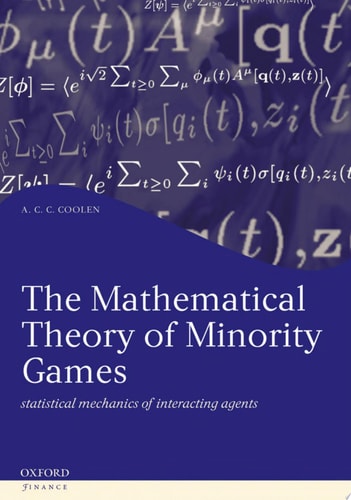
The Mathematical Theory of Minority Games
0
0
As an Amazon Associate and affiliate partner, Menrva Books earns from qualifying purchases. Learn more
Author Description
Minority games are simple mathematical models initially designed to understand the co-operative phenomena observed in markets. Their core ingredients are large numbers of interacting decision-making agents, each aiming for personal gain in an artificial `market' by trying to anticipate (on the basis of incomplete information, and with an element of irrationality) the actions of others. Gain is made by those who subsequently find themselves in the minority group, e.g. those who end up buying when most wish to sell or vice versa. Aimed at researchers and students in physics, mathematics and economics this text describes the mathematical theory of Minority Games from a statistical mechanics viewpoint. It provides a detailed and explicit introduction to the advanced mathematical analysis of these models, describes the potential and restrictions of physical methods in solving agent based market models, and outlines how different mathematical approaches are related.
Menrva's Summary
THE THESIS
This book investigates the mathematical underpinnings of minority games, models designed to elucidate cooperative phenomena in markets. The text, aimed at researchers and students in physics, mathematics, and economics, provides a detailed introduction to the advanced mathematical analysis of these models from a statistical mechanics perspective. It explores the potential and restrictions of physical methods in solving agent-based market models and clarifies the relationships between different mathematical approaches.
THE SCOPE MAP
- Detailed mathematical theory of Minority Games from a statistical mechanics viewpoint.
- Explicit introduction to advanced mathematical analysis of these models.
- Discussion of the potential and restrictions of physical methods in solving agent-based market models.
- Outline of how different mathematical approaches are related.
- Focus on interacting decision-making agents aiming for personal gain in artificial markets.
- Explanation of how gain is achieved by those in the minority group.
THE AUTHORITY PERSPECTIVE
The book is presented as a comprehensive treatment of the mathematical theory of minority games, suitable for advanced students and researchers. Its focus on statistical mechanics and agent-based modeling suggests a rigorous, analytical approach to understanding market dynamics. The text aims to bridge concepts from physics, mathematics, and economics, offering a unified perspective on these complex systems.
Page Count:
344
Publication Date:
2005-01-06
Publisher:
Oxford University Press Academic UK
ISBN-10:
0191545503
ISBN-13:
9780191545504
Science
Non-Fiction
Economics
Mathematics
Statistical mechanics
Community Tags
Similar Books