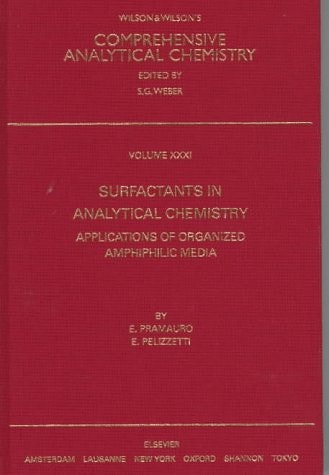
Surfactants in Analytical Chemistry: Applications of Organized Amphiphilic Media
0
0
As an Amazon Associate and affiliate partner, Menrva Books earns from qualifying purchases. Learn more
Author Description
Provided here is a collective source of data covering the actual uses of amphiphilic organized media in analytical chemistry and an explanation of the mechanisms by which these systems exert their different functions in each analytical scheme. The volume has been organized into two parts. The first part, consisting of three chapters, describes the structural features and properties of amphiphilic aggregates and the analysis of the interactions between analytes and these assemblies. Attention is focussed on the distribution and location of solutes within the different regions of the microheterogeneous media, and on the observed effects on chemical equilibria, kinetics and molecular properties of substrates. The second part, comprising five chapters, centers on the applications of amphiphilic systems in specific analytical techniques, such as spectroscopy, chromatography, electroanalysis, etc. The role of surfactant aggregates is examined in the light of existing theories and models, and performances are compared with those obtained with traditional methods. The potential interest of some recently developed surfactant-based separations, such as extractions with reversed micelles or micellar-enhanced ultrafiltration, in biotechnology and pollution control is also underlined. Finally, the need for new functionalized surfactants, designed specifically for the novel analytical applications is considered, e.g. the preparation of chelating micelles obtained from suitable amphiphilic ligands and their performances as extracting systems for metal ions are described. Researchers working on the applications of surfactants in environmental chemistry and biotechnology and organic and physical chemists concerned with reactivity and synthesis in organized media will find this a valuable text.
Menrva's Summary
THE THESIS
This book investigates the fundamental principles and practical applications of surfactants and organized amphiphilic media within the field of analytical chemistry. It details how these systems function in various analytical schemes, focusing on the interactions between analytes and amphiphilic aggregates, and their effects on chemical equilibria, kinetics, and molecular properties. The work is structured into two parts, first exploring the properties of amphiphilic aggregates and solute distribution, then delving into specific applications in techniques like spectroscopy and chromatography.
THE SCOPE MAP
- Structural features and properties of amphiphilic aggregates
- Analysis of interactions between analytes and amphiphilic assemblies
- Distribution and location of solutes within microheterogeneous media
- Effects on chemical equilibria, kinetics, and molecular properties
- Applications in spectroscopy
- Applications in chromatography
- Applications in electroanalysis
- Comparison of surfactant-based performances with traditional methods
THE AUTHORITY PERSPECTIVE
This comprehensive text is designed for researchers in environmental chemistry, biotechnology, and physical chemistry who work with organized media. It provides a detailed examination of surfactant applications in analytical techniques, comparing their performance to established methods. The book also highlights emerging areas such as biotechnology and pollution control, and discusses the development of new functionalized surfactants for specific analytical tasks, like the extraction of metal ions.
Page Count:
521
Publication Date:
1996-08-09
Publisher:
Elsevier Science
ISBN-10:
0444890335
ISBN-13:
9780444890337
Science
Non-Fiction
Surfactants
Analytical Chemistry
Physical Chemistry
Community Tags
Similar Books