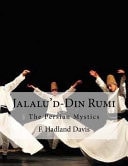
Jalalu'd-Din Rumi: The Persian Mystics
0
0
As an Amazon Associate and affiliate partner, Menrva Books earns from qualifying purchases. Learn more
Author Description
Sufism is a school for the actualization of divine ethics. It involves an enlightened inner being, not intellectual proof; revelation and witnessing, not logic. By divine ethics, we are referring to ethics that transcend mere social convention, a way of being that is the actualization of the attributes of God. To explain the Truth is indeed a difficult task. Words, being limited, can never really express the perfection of the Absolute, the Unbound. Thus, for those who are imperfect, words create doubt and misunderstanding. Yet: If one cannot drink up the entire ocean, one can drink to one's limit. Philosophers have written volumes and spoken endlessly of the Truth, but somehow their efforts have always fallen short. For the sufi, philosophers are those who view the Perfection of the Absolute from a limited perspective; so all they see is part of the Absolute, not the Infinite in its entirety. It is indeed true that what philosophers see is correct; nevertheless, it is only a part of the whole. One is reminded of Rumi's well-known story of a group of men in India who had never seen an elephant. One day they came to a place where an elephant was. In complete darkness they approached the animal, each man feeling it. Afterwards, they described what they thought they had perceived. Of course their descriptions were different. The one who felt a leg, imagined the elephant to be a pillar. The one who felt the animal's ear, described the elephant as a fan, and so on. Each one of their descriptions with respect to the various parts they had experienced was true. However, as far as accurately describing the whole, their conceptions had all fallen short. If they had had a candle, the difference of opinions would not have come about. The candle's light would have revealed the elephant as a whole. Only by the light of the Spiritual Path and the mystic way can the Truth be discovered. In order for one to truly witness the Perfection of the Absolute, one must see with one's inner
Menrva's Summary
THE THESIS
This book explores the core tenets of Sufism as a path to actualizing divine ethics, emphasizing inner experience over intellectual proof. The text posits that Sufism involves an enlightened inner being and a way of being that reflects the attributes of God, transcending mere social convention. It addresses the inherent limitations of language in expressing absolute truth, likening the philosophical pursuit of truth to blind men describing an elephant, each perceiving only a part. The author argues that only through the spiritual path and mystic way can the Truth be fully apprehended.
THE SCOPE MAP
- Explanation of Sufism as a school for the actualization of divine ethics.
- Distinction between inner experience/revelation and intellectual proof/logic in Sufism.
- Discussion on the limitations of language in expressing absolute truth.
- Analogy of the blind men and the elephant to illustrate partial understanding versus holistic truth.
- Emphasis on the Spiritual Path and mystic way as the means to discover Truth.
- The concept of divine ethics as the actualization of God's attributes.
THE AUTHORITY PERSPECTIVE
The provided description frames this work as an exploration of Sufi philosophy and practice, likely appealing to readers interested in comparative religion, mysticism, and spiritual inquiry. The text's focus on the experiential nature of Sufism and its critique of purely intellectual approaches suggests a thoughtful engagement with theological and philosophical concepts. The use of parables, such as the elephant analogy, indicates a pedagogical approach aimed at conveying complex ideas in an accessible manner. The book appears to offer insights into a profound spiritual tradition, inviting readers to consider different pathways to understanding ultimate truth.
Page Count:
62
Publication Date:
2017-03-06
Publisher:
CreateSpace Independent Publishing Platform
ISBN-10:
1544220022
ISBN-13:
9781544220024
Spirituality
Philosophy
Non-Fiction
Mysticism
Sufism
Community Tags
Similar Books











Reader Comments
Share Your Thoughts
No comments yet. Be the first to share your thoughts!