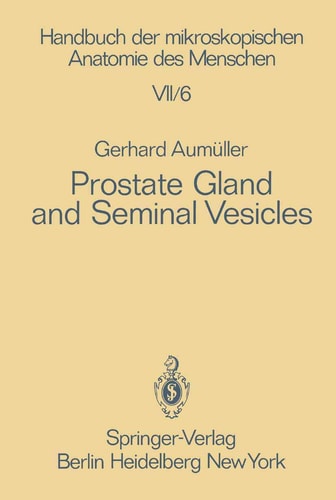
Prostate Gland and Seminal Vesicles
0
0
As an Amazon Associate and affiliate partner, Menrva Books earns from qualifying purchases. Learn more
Author Description
When STIEVE published his work on male reproductive organs in this handbook in 1930, a definitive treatment of the morphology of the accessory sex glands seemed accomplished. Nevertheless, the increasing bulk of scientific literature published in the last years on this topic has demonstrated that new methods, e. g., developments in the fields of electron microscopy, cytochemistry and auto radiography, pose new questions. These principally morphological techniques have yielded new insights into the fine structure and functional organization of these glands. The stress, however, lay on biochemical questions concerning the mechanism of hormone action, since the accessory sex glands were considered to be primary target organs of hormone action, i. e., their cells bind specific hormones. Besides the basic interest of endocrinologists, morphologists, and biochemists, several unanswered questions arose from the practitioners, e. g., urologists, andrologists, and other clinicians, especially as regards the prostate gland, one of the organs most affected in elderly men. Thus, the epidemiologic investigations of the last years proved this very organ to be one of the most frequent causes of death in elderly men (HANSEN, 1977). The view of the practi tioner established a special field of investigation and effected a shift from morphologic analysis to biochemical or endocrine aspects. Nevertheless, mor phology, if tempered by experimental or concomitant biochemical studies, pro vides a solid base for tracing the pathologic events occurring in these organs.
Menrva's Summary
THE THESIS
This book investigates the evolving understanding of the prostate gland and seminal vesicles, particularly in light of new research methods and clinical questions. Drawing on the author's expertise and a synthesis of recent scientific literature, this work examines the fine structure and functional organization of these glands, incorporating insights from electron microscopy, cytochemistry, and autoradiography. It addresses the shift in focus towards biochemical and endocrine aspects, driven by the glands' role as primary target organs for hormone action, while emphasizing the foundational importance of morphology in understanding pathological changes, especially concerning the prostate in elderly men.
THE SCOPE MAP
- Detailed morphological and functional analysis of the prostate gland and seminal vesicles.
- Integration of findings from advanced techniques like electron microscopy, cytochemistry, and autoradiography.
- Exploration of the biochemical and endocrine aspects of these glands, including hormone action.
- Discussion of clinical relevance, particularly for urologists and andrologists, and the high incidence of prostate issues in elderly men.
THE AUTHORITY PERSPECTIVE
This work is positioned as a comprehensive update to the understanding of male accessory sex glands, building upon earlier foundational texts. The text acknowledges the rapid advancements in research methodologies and the increasing clinical significance of these organs, particularly the prostate. It aims to bridge the gap between morphological studies and newer biochemical and endocrine investigations, providing a solid basis for understanding disease processes. The book is likely intended for endocrinologists, morphologists, biochemists, and clinicians such as urologists and andrologists seeking detailed, up-to-date information.
Page Count:
380
Publication Date:
1979-07-01
Publisher:
Springer Berlin Heidelberg
ISBN-10:
3540091912
ISBN-13:
9783540091912
Non-Fiction
Science
Anatomy
Urology
Histology
Endocrinology
Biochemistry
Community Tags
Similar Books