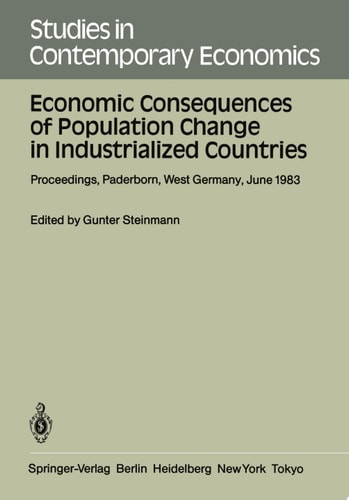
Economic Consequences of Population Change in Industrialized Countries: Proceedings of the Conference on Population Economics Held at the University of Paderborn, West Germany, June 1–3, 1983
0
0
As an Amazon Associate and affiliate partner, Menrva Books earns from qualifying purchases. Learn more
Author Description
The recent experience of industrialized countries with low fer tility and persistent immigration has stimulated interest in the eco nomic effects of population change in industrial countries and has led to new research in population economics. In Germany, however, where these demographic trends were perhaps most pronounced, research on po pulation economics has lagged. During recent years more German econo mists have also turned to this topic. This upsurge in research activity motivated the organisation of an international conference entitled "Economic Consequences of Population Change in Industrialized Coun tries", which was held from June 1 to June 3, 1983 at the University of Paderborn, W. Germany. The conference was designed to discuss and assess the new theoretical and empirical research work on the effects of population change on the economy, to intensify the international cooperation and to stimulate the research in population economics in W. Germany. This volume contains 23 revised versions of the 27 papers pre sented at the conference. Although the topics of the papers are di verse, they can be grouped into six general themes: The first section, including papers by Cigno, Steinmann, and Simon, deals with models of the secular interrelationships between population change, technical progress and economic growth. The models are built upon the framework of neoclassical growth theory and are extended by the assumption that the rate of technical progress is positively linked with population growth or population density.
Menrva's Summary
THE THESIS
This volume investigates the economic ramifications of demographic shifts within industrialized nations. The book compiles revised papers from a 1983 conference at the University of Paderborn, Germany, addressing the economic effects of low fertility and persistent immigration. It aims to discuss and assess new theoretical and empirical research, foster international cooperation, and stimulate research in population economics, particularly within Germany. The papers explore diverse topics, including models of the interrelationships between population change, technical progress, and economic growth, often built upon neoclassical growth theory with assumptions linking technical progress to population growth or density.
THE SCOPE MAP
- Models of secular interrelationships between population change, technical progress, and economic growth.
- Analysis of the effects of population change on the economy.
- Theoretical and empirical research on population economics.
- Discussion of demographic trends in industrialized countries, including low fertility and immigration.
- Papers grouped into six general themes.
- Contributions from international researchers in population economics.
THE AUTHORITY PERSPECTIVE
This collection of papers from a 1983 conference offers a snapshot of research in population economics during a period of significant demographic change in industrialized countries. The focus on theoretical and empirical work suggests a text aimed at academics and researchers in the field. The inclusion of revised papers indicates a curated selection intended to present a cohesive overview of the state of knowledge at the time, likely appealing to those interested in the intersection of demography and economic policy.
Page Count:
415
Publication Date:
2012-12-06
Publisher:
Springer Science & Business Media
ISBN-10:
3642864783
ISBN-13:
9783642864780
Non-Fiction
Economics
Demographics
Economic Growth
Population Studies
Community Tags
Similar Books