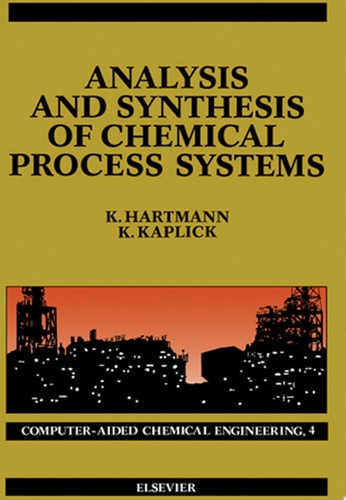
Analysis and Synthesis of Chemical Process Systems
0
0
As an Amazon Associate and affiliate partner, Menrva Books earns from qualifying purchases. Learn more
Author Description
The methods used by chemists and chemical engineers for the conception, design and operation of chemical process systems have undergone significant changes in the last 10 years. The most important of modern computer-aided techniques are process analysis and process system synthesis, both of which are closely related. The first part of the book presents the principles of model building, simulation and model application. On the basis of an appropriate set of hierarchical levels of chemical systems, the general strategy of analysis by deterministic and statistical methods is treated. The second part deals with process system synthesis beginning with reaction path analysis. One of the major features of this part are new methods for the synthesis of reactor networks, separation sequences, heat-exchanger systems and entire chemical process systems by a combined procedure of heuristic rules and fuzzy set algorithms. This procedure, which is known as knowledge engineering, is an efficient combination of human creativity and theoretically based knowledge. This book, which is illustrated by examples, should prove extremely useful as a text for a senior/graduate course for students of chemistry and chemical engineering and will also be invaluable for chemists and chemical engineers in research and industry, and specialists dealing with the analysis and synthesis of process systems.
Menrva's Summary
THE THESIS
This book investigates the evolution of methods for designing and operating chemical process systems, focusing on modern computer-aided techniques. It presents principles of model building, simulation, and application, treating the general strategy of analysis through deterministic and statistical methods on hierarchical levels of chemical systems. The second part details process system synthesis, introducing new methods for reactor networks, separation sequences, heat-exchanger systems, and entire process systems using a combination of heuristic rules and fuzzy set algorithms, a procedure termed knowledge engineering. This approach efficiently merges human creativity with theoretical knowledge, illustrated through examples.
THE SCOPE MAP
- Principles of model building, simulation, and model application in chemical process systems.
- Analysis of chemical systems using deterministic and statistical methods across hierarchical levels.
- Synthesis of reactor networks.
- Synthesis of separation sequences.
- Synthesis of heat-exchanger systems.
- Combined procedure of heuristic rules and fuzzy set algorithms for process system synthesis.
- Application of knowledge engineering principles merging human creativity and theoretical knowledge.
- Illustrated examples of the presented methods.
THE AUTHORITY PERSPECTIVE
The book is presented as an extremely useful text for senior/graduate students in chemistry and chemical engineering, as well as an invaluable resource for professionals in research, industry, and specialists in process systems analysis and synthesis. The content addresses significant changes in the field over the last decade, highlighting advanced computer-aided techniques. The approach combines established analytical methods with novel synthesis procedures, suggesting a comprehensive and practical guide for its intended audience.
Page Count:
235
Publication Date:
2016-10-06
Publisher:
Elsevier S & T
ISBN-10:
1483291669
ISBN-13:
9781483291666
Science
Non-Fiction
Chemical Engineering
Simulation
Computer Aided Design
Community Tags
Similar Books