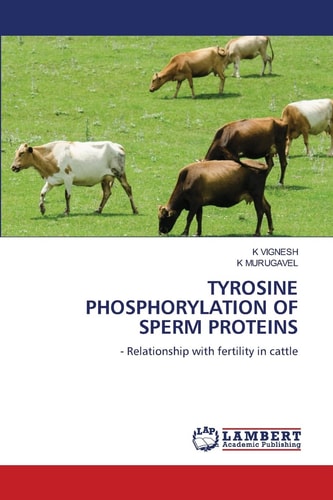
Tyrosine Phosphorylation of Sperm Proteins: Relationship with Fertility in Cattle
0
0
As an Amazon Associate and affiliate partner, Menrva Books earns from qualifying purchases. Learn more
Author Description
Crossbred dairy cattle provide 27% of the total milk produced in the nation, which points out the importance of crossbreeding programme in India. Both male and female animal contributes equally to this condition but, male infertility is of major concern as a single bull is used to inseminate several thousands of cows. Further, in crossbred bulls, the incidence of poor semen quality and susceptibility of spermatozoa to cryodamages are very high. Recent evidence indicates that protein tyrosine phosphorylation (PTP) also occurs during cryopreservation and is associated with cryo-capacitation, a phenomena detrimental to sperm fertilizing potential. Simultaneous assessment of sperm functional attributes and PTP has helped in understanding the relationship of PTP with other important sperm functional characteristics thus the fertilizing potential. The present study confirms that proportion of post-thaw motile spermatozoa was significantly higher in above-average bulls, although every bull used in the experiment qualified the minimum requirement of 50% and above.
Menrva's Summary
THE THESIS
This study investigates the role of protein tyrosine phosphorylation (PTP) in sperm function and its correlation with fertility in crossbred dairy cattle. The research addresses the critical issue of male infertility in cattle, particularly in crossbred bulls where poor semen quality and cryodamage susceptibility are prevalent. By simultaneously assessing sperm functional attributes and PTP levels, the study aims to elucidate the relationship between PTP and sperm fertilizing potential, especially following cryopreservation.
THE SCOPE MAP
- Analysis of semen quality and fertilizing potential in crossbred dairy bulls.
- Investigation of protein tyrosine phosphorylation (PTP) during sperm cryopreservation.
- Correlation between PTP levels and sperm cryo-capacitation.
- Assessment of sperm functional attributes, including motility, post-thaw.
- Relationship between PTP and overall sperm fertilizing capacity.
- Comparison of PTP in above-average fertility bulls versus average bulls.
THE AUTHORITY PERSPECTIVE
This research contributes to the understanding of male reproductive efficiency in cattle, a critical factor for dairy production. The study's focus on protein tyrosine phosphorylation offers a biochemical perspective on sperm function and cryosurvival. The findings suggest a link between PTP and sperm motility post-thaw, potentially aiding in the selection of bulls with superior fertility.
Page Count:
80
Publication Date:
2024-10-17
Publisher:
LAP LAMBERT Academic Publishing
ISBN-10:
6208171369
ISBN-13:
9786208171360
Non-Fiction
Science
Veterinary Medicine
Animal Science
Reproductive Biology
Biochemistry
Community Tags
Similar Books