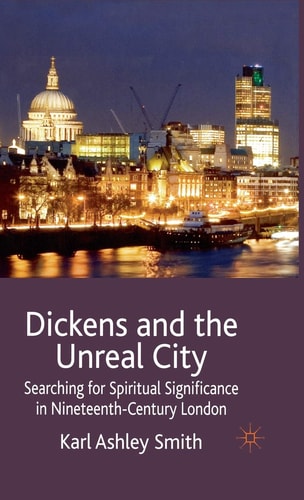
Dickens and the Unreal City: Searching for Spiritual Significance in Nineteenth-Century London
0
0
As an Amazon Associate and affiliate partner, Menrva Books earns from qualifying purchases. Learn more
Author Description
Dickens's London often acts as a complex symbol, composed of numerous sub-symbols, such as crowd, river, railway networks and police systems. This book is particularly interested in how Dickens's treatment of the city allows him to re-examine traditional Christian discourses on the issues of revelation, renunciation and regeneration.
Menrva's Summary
THE THESIS
This book investigates how Charles Dickens utilized the symbolic landscape of nineteenth-century London to explore and re-examine core Christian concepts. The author, K. Smith, examines Dickens's literary treatment of the city, dissecting its constituent symbols like crowds, river systems, and policing to understand how they function within his narratives. The central argument posits that Dickens's urban settings are not merely backdrops but active agents in his reinterpretation of revelation, renunciation, and regeneration, offering a unique lens through which to view spiritual significance in the Victorian era.
THE SCOPE MAP
- Analysis of Dickens's symbolic use of London's physical and social structures.
- Exploration of how urban elements like crowds, rivers, and railways function as literary symbols.
- Examination of Dickens's engagement with traditional Christian discourses on revelation.
- Investigation into Dickens's portrayal of renunciation within the urban context.
- Analysis of the theme of regeneration as depicted through the city.
- Focus on specific novels and passages where these themes are most prominent.
- Discussion of the spiritual significance found within the material realities of Victorian London.
THE AUTHORITY PERSPECTIVE
The book is recognized for its focused examination of Dickens's urban symbolism and its connection to spiritual themes. It is noted for its detailed analysis of how Dickens employs the city as a complex symbolic entity to re-evaluate Christian doctrines. The work is considered a valuable contribution to Victorian literary studies, particularly for scholars interested in the intersection of literature, urbanism, and religion.
Page Count:
253
Publication Date:
2008-07-15
Publisher:
Palgrave Macmillan
ISBN-10:
0230545238
ISBN-13:
9780230545236
Non-Fiction
Victorian
Literary Criticism
Urban Studies
Community Tags
Similar Books