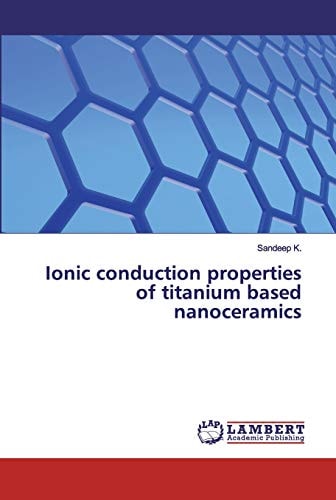
Ionic Conduction Properties of Titanium Based Nanoceramics
0
0
As an Amazon Associate and affiliate partner, Menrva Books earns from qualifying purchases. Learn more
Author Description
Materials science and engineering plays a vital role in this modern age of science and technology. Titanium based electronic ceramic materials show good electrical, optical and dielectric properties. The book describes the ionic conduction properties of titanium based nanomaterials synthesized using modified combustion technique. These materials find applications in biomedical, electro-optical, solid oxide fuel cells, solar cells, communication and optical systems. Ionic conduction in a crystalline material is mainly due to the concentration of impurities, dopants and point defects in the crystalline lattice. In ionic solids, while carrier concentration is independent of temperature (within extrinsic region), however the mobility is strongly affected by temperature. Ionic conduction properties of some titante compounds with varied temperature are described. This book, therefore, shed light on the practical usefulness of some minerals especially that are reported in chapter 3 and chapter 5. The properties of these materials can be tailored by suitable doping and substitution and also by mixing compounds in particular proportions. This type of an effort is carried out in chapter 4.
Menrva's Summary
THE THESIS
This book investigates the ionic conduction properties of titanium-based nanoceramics, crucial materials for modern technology. The author, Sandeep K., details the synthesis of these nanomaterials using a modified combustion technique, focusing on their electrical, optical, and dielectric characteristics. The text explores how ionic conduction is influenced by impurities, dopants, and point defects within the crystalline lattice, and how temperature affects carrier mobility. Practical applications in fields such as biomedical engineering, solid oxide fuel cells, and solar energy are highlighted, with specific attention given to tailoring material properties through doping, substitution, and compound mixing.
THE SCOPE MAP
- Detailed description of ionic conduction mechanisms in crystalline materials.
- Synthesis of titanium-based nanomaterials via modified combustion technique.
- Analysis of electrical, optical, and dielectric properties of these ceramics.
- Exploration of temperature-dependent ionic mobility.
- Discussion of applications in biomedical, electro-optical, and energy systems.
- Methods for tailoring material properties through doping and substitution.
- Specific case studies presented in chapters 3, 4, and 5.
THE AUTHORITY PERSPECTIVE
This book offers a focused examination of titanium-based nanoceramics, likely appealing to materials scientists and engineers. The detailed discussion of ionic conduction mechanisms and synthesis methods suggests a technical audience. Its exploration of applications in energy and electronics indicates relevance for researchers and developers in those fields. The emphasis on tailoring material properties points to a practical, applied science perspective.
Page Count:
136
Publication Date:
2019-06-05
Publisher:
LAP LAMBERT Academic Publishing
ISBN-10:
6200211566
ISBN-13:
9786200211569
Science
Non-Fiction
Solar Cells
Ceramics
Community Tags
Similar Books