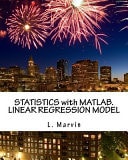
Statistics with MATLAB: Linear Regression Model
0
0
As an Amazon Associate and affiliate partner, Menrva Books earns from qualifying purchases. Learn more
Author Description
Regression models describe the relationship between a response (output) variable, and one or more predictor (input) variables. Statistics and Machine Learning Toolbox allows you to fit linear, generalized linear, and nonlinear regression models, including stepwise models and mixed-effects models. Once you fit a model, you can use it to predict or simulate responses, assess the model fit using hypothesis tests, or use plots to visualize diagnostics, residuals, and interaction effects. Statistics and Machine Learning Toolbox also provides nonparametric regression methods to accommodate more complex regression curves without specifying the relationship between the response and the predictors with a predetermined regression function. You can predict responses for new data using the trained model. Gaussian process regression models also enable you to compute prediction intervals This book develops the linear model of regression taking into account the stages of identification, estimation, diagnosis and prediction. The most important content is the following: -Parametric Regression Analysis -Choose a Regression Function -Linear Regression -Prepare Data -Choose a Fitting Method -Choose a Model or Range of Models -Fit Model to Data -Examine Quality and Adjust the Fitted Model -Predict or Simulate Responses to New Data -Share Fitted Models -Linear Regression Workflow -Linear Regression with Interaction Effects -Interpret Linear Regression Results -Cook's Distance -Coefficient Standard Errors and Confidence Intervals -Coefficient Covariance and Standard Errors -Coefficient Confidence Intervals -Coefficient of Determination (R-Squared) -Durbin-Watson Test -F-statistic -Assess Fit of Model Using F-statistic -t-statistic -Assess Significance of Regression Coefficients Using t-statistic -Hat Matrix and Leverage -Residuals -Assess Model Assumptions Using Residuals -Summary of Output and Diagnostic Statistics -Wilkinson Notation -Linear Mixed-Effects Model Examples -Generalized Lin
Menrva's Summary
THE THESIS
This book investigates the fundamental principles and practical applications of linear regression modeling, with a specific focus on its implementation using MATLAB. It details the stages of identification, estimation, diagnosis, and prediction within regression analysis, providing a comprehensive framework for understanding the relationship between response and predictor variables. The content covers parametric regression analysis, the selection of appropriate regression functions and fitting methods, and the examination of model quality through various statistical tests and diagnostic plots. Readers will learn to predict responses for new data, share fitted models, and interpret results using tools like R-squared, F-statistics, t-statistics, and residual analysis.
THE SCOPE MAP
- Parametric Regression Analysis
- Choosing a Regression Function
- Linear Regression Techniques
- Data Preparation for Regression
- Model Fitting Methods
- Model Evaluation and Adjustment
- Prediction and Simulation of Responses
- Interpretation of Linear Regression Results
THE AUTHORITY PERSPECTIVE
The book appears to offer a structured approach to linear regression, emphasizing practical application through MATLAB. Its detailed breakdown of the regression workflow, from data preparation to model interpretation and prediction, suggests a thorough treatment of the subject matter. The inclusion of specific statistical concepts like Cook's Distance, coefficient standard errors, R-squared, and various hypothesis tests indicates a focus on rigorous analysis and model validation. This content suggests the book is aimed at students or practitioners seeking a solid understanding of regression modeling within a computational context.
Page Count:
208
Publication Date:
2017-11-02
Publisher:
CreateSpace Independent Publishing Platform
ISBN-10:
1979364095
ISBN-13:
9781979364096
Non-Fiction
Science
Statistics
Data Science
Machine Learning
MATLAB
Community Tags
Similar Books