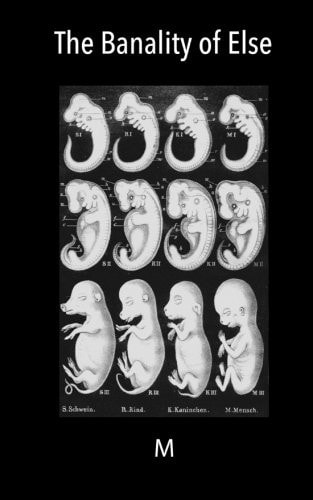
The Banality of Else
0
0
As an Amazon Associate and affiliate partner, Menrva Books earns from qualifying purchases. Learn more
Author Description
The Banality of Else is a surreal/ fragmentary/ discursive series of texts written in the disembodied vocal style. Apocalyptic in atmosphere, it utilizes corporeal imagery to illustrate its conceptual points. The book deals in the first instance with the conflict between the 'else', (the 'other than'), perceived as a reflexive banality, and the 'none' (nothingness/ purity); 'else' as the 'in-dreaming of the self to follow', the 'deflect of self-reflect'. The second section, 'Of Dissipating Emblems', deals with the unquantifiability of silence, and the conflict of words in that context, ('the stain of emptily'), also with words and their response to the 'nothing'. 'Of the Dead Airs' deals with finality and the incapacity/ obliteration of words before the 'naught', the 'fade to absent traces'. 'The Redundant Pulse', the final section of the book, posits that the human experience is now an endgame, (if it ever had any meaning at all), and should not continue any further...
Menrva's Summary
THE PULSE
The human experience, now perceived as an endgame, faces the void of nothingness. The text explores the conflict between the 'else'—a reflexive banality and the self's future projection—and the 'none,' representing nothingness or purity. It delves into the unquantifiability of silence and the struggle of words against this void, ultimately questioning the meaning and continuation of human existence.
INSIDE THE PAGES
- Exploration of the 'else' as a reflexive banality and the 'other than'
- Confrontation with 'none' as nothingness and purity
- Analysis of the unquantifiability of silence and the role of words
- Examination of words' response to 'nothingness'
- Discussion of finality and the obliteration of words before the 'naught'
- Positing the human experience as an endgame with questionable meaning
- Discursive and fragmentary textual style
- Use of corporeal imagery to illustrate conceptual points
THE COLLECTIVE ECHO
The Banality of Else is characterized by its surreal, fragmentary, and discursive style, employing a disembodied vocal quality. Its apocalyptic atmosphere and use of corporeal imagery serve to illustrate complex conceptual points about existence and nothingness. The work is structured into distinct sections, each probing different facets of this existential conflict, from the nature of self and silence to the finality of human experience. The text appears to be a philosophical exploration rather than a narrative-driven work, focusing on abstract concepts and their linguistic representation.
Page Count:
78
Publication Date:
2015-01-08
Publisher:
gnOme
ISBN-10:
0692366245
ISBN-13:
9780692366240
Fiction
Literary Fiction
Philosophy
Experimental
Community Tags
Similar Books