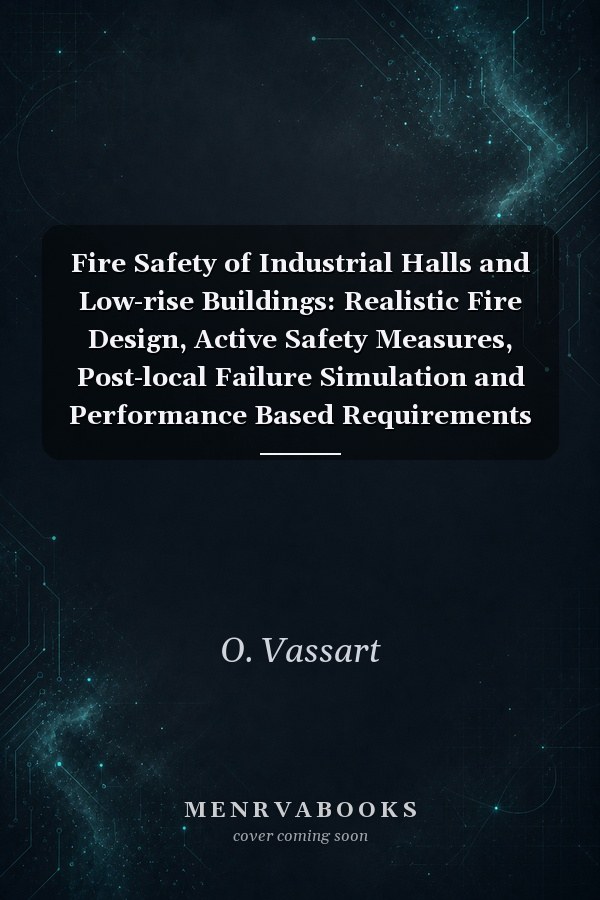
Fire Safety of Industrial Halls and Low-rise Buildings: Realistic Fire Design, Active Safety Measures, Post-local Failure Simulation and Performance Based Requirements
0
0
As an Amazon Associate and affiliate partner, Menrva Books earns from qualifying purchases. Learn more
Author Description
New fire safety regulation proposals for single-storey buildings have appeared in different countries (France, Spain, and Belgium), and could result in a significant loss of market share for steel. The steel industry must be ready to provide strong technical arguments and solutions to avoid the introduction of excessive fire resistance requirements for single storey buildings throughout Europe. The primary aim of this research was to prove that the fire safety of steel single-storey buildings is sufficient, in the absence of passive fire protection, by means of risk assessment and structural simulations showing that the safety of people and firemen is ensured. The safety of firemen is guaranteed by a safe failure mode and non-progressive collapse behaviour of the structure. This methodology was also extended to low level multi-storey structures (two to four storeys). In a first step of the research, the dynamic approach for FEM calculation in case of fire, was developed and introduced into the SAFIR software. The SAFIR, ANSYS and ABAQUS software are now able to pass through local instabilities and calculate the behaviour until the complete failure of the structure in the fire compartment. In that way the non-progressive collapse can be assessed. Using the updated software versions, a parametrical study was made on single-storey buildings. Simplified methodologies have been deduced in order to calculate unprotected steel structures for industrial and storage halls. This project provides a way of guaranteeing the safety of occupants and firemen through alternatives to prescriptive ISO fire requirements.
Menrva's Summary
THE THESIS
This research investigates the fire safety of industrial halls and low-rise steel buildings, aiming to counter new regulations that could disadvantage steel construction. The study focuses on demonstrating that steel structures, even without passive fire protection, can ensure the safety of occupants and firefighters through advanced risk assessment and structural simulations. It extends this methodology to low-rise multi-story buildings, developing dynamic FEM calculation approaches and refining software like SAFIR, ANSYS, and ABAQUS to simulate structural behavior until complete failure, thereby assessing non-progressive collapse.
THE SCOPE MAP
- Development and introduction of a dynamic approach for FEM calculation in case of fire into SAFIR software.
- Enhancement of SAFIR, ANSYS, and ABAQUS software to handle local instabilities and calculate behavior until complete failure.
- Assessment of non-progressive collapse behavior of steel structures under fire conditions.
- Parametric study on single-storey buildings using updated software versions.
- Deduction of simplified methodologies for calculating unprotected steel structures in industrial and storage halls.
- Provision of alternatives to prescriptive ISO fire requirements for ensuring occupant and firefighter safety.
- Extension of the methodology to low-level multi-storey structures (two to four storeys).
THE AUTHORITY PERSPECTIVE
The research presented in this report aims to provide the steel industry with robust technical arguments and solutions to address new fire safety regulation proposals for single-storey buildings. By demonstrating the sufficiency of fire safety in steel structures through advanced simulation and risk assessment, the project seeks to prevent the imposition of excessive fire resistance requirements across Europe. The methodology developed offers a performance-based approach as an alternative to prescriptive standards, focusing on ensuring structural integrity and occupant safety during fire events.
Page Count:
328
Publication Date:
2007-01-01
Publisher:
Office for Official Publications of the European Communities
ISBN-10:
9279050044
ISBN-13:
9789279050046
Science & Technology
Non-Fiction
Engineering
Building Codes
Structural analysis
Fire Safety
Community Tags
Similar Books