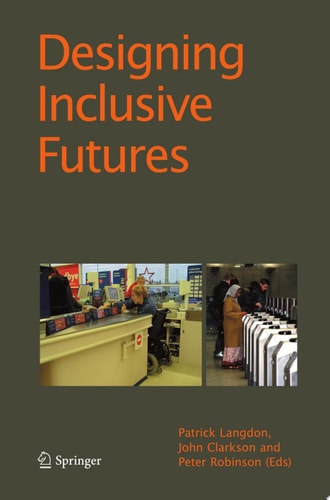
Designing Inclusive Futures
0
0
As an Amazon Associate and affiliate partner, Menrva Books earns from qualifying purchases. Learn more
Author Description
“Designing Inclusive Futures” reflects the need to explore, in a coherent way, the issues and practicalities that lie behind design that is intended to extend our active future lives. This encompasses design for inclusion in daily life at home but also extends to the workplace and for products within these contexts. For example, given trends in employment sector growth, skills requirements, labour supply and demographic change, there is a need to predict the critical areas where individual capabilities are mismatched with the physical, social and organisational demands of work. This mismatch, which can be addressed within the domain of inclusive design, is pervasively linked to real artefacts in workspaces and their intersection with the health factors that relate to ageing. This book is the result of the fourth CWUAAT workshop held in Cambridge, England in April 2008.
Menrva's Summary
THE THESIS
This book investigates the practicalities and issues surrounding design that aims to extend active future lives, focusing on inclusion in daily life, the workplace, and product contexts. The authors address the growing need to predict critical areas where individual capabilities may not match the demands of work, particularly in light of demographic changes and evolving employment sectors. It examines how inclusive design principles can bridge these mismatches, with a specific focus on the intersection of workspace artifacts, health factors, and the aging population. The content is derived from the fourth Cambridge Workshop on Universal Access and Assistive Technology (CWUAAT) held in April 2008.
THE SCOPE MAP
- Exploration of inclusive design principles for daily life and home environments.
- Analysis of workplace demands and the mismatch with individual capabilities.
- Consideration of demographic changes, employment trends, and skills requirements.
- Focus on the intersection of physical workspace artifacts and health factors related to aging.
- Discussion of practicalities and issues in designing for extended active futures.
- Content derived from the CWUAAT workshop proceedings.
- Application of inclusive design to products within home and work contexts.
THE AUTHORITY PERSPECTIVE
The book presents a focused exploration of inclusive design, particularly concerning the challenges posed by an aging population and evolving work environments. Its foundation in the CWUAAT workshop suggests a collection of research-oriented perspectives and practical considerations. The content likely appeals to designers, ergonomists, and policymakers interested in human factors and accessibility in product and workplace design. The emphasis on practicalities and specific examples indicates a resource aimed at professionals and researchers in the field.
Page Count:
274
Publication Date:
2008-03-07
Publisher:
Springer Science & Business Media
ISBN-10:
1848002114
ISBN-13:
9781848002111
Science & Technology
Non-Fiction
Ergonomics
Product design
Human Factors
Workplace Design
Community Tags
Similar Books