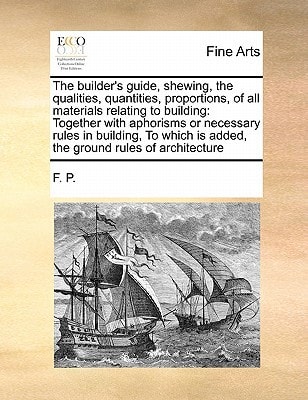
The Builder's Guide, Shewing, the Qualities, Quantities, Proportions, of All Materials Relating to Building: Together with Aphorisms or Necessary ... Is Added, the Ground Rules of Architecture
0
0
As an Amazon Associate and affiliate partner, Menrva Books earns from qualifying purchases. Learn more
Author Description
The 18th century was a wealth of knowledge, exploration and rapidly growing technology and expanding record-keeping made possible by advances in the printing press. In its determination to preserve the century of revolution, Gale initiated a revolution of its own: digitization of epic proportions to preserve these invaluable works in the largest archive of its kind. Now for the first time these high-quality digital copies of original 18th century manuscripts are available in print, making them highly accessible to libraries, undergraduate students, and independent scholars. The eighteenth-century fascination with Greek and Roman antiquity followed the systematic excavation of the ruins at Pompeii and Herculaneum in southern Italy; and after 1750 a neoclassical style dominated all artistic fields. The titles here trace developments in mostly English-language works on painting, sculpture, architecture, music, theater, and other disciplines. Instructional works on musical instruments, catalogs of art objects, comic operas, and more are also included. ++++ The below data was compiled from various identification fields in the bibliographic record of this title. This data is provided as an additional tool in helping to insure edition identification: ++++ Huntington Library N015223 'The carpenter's plain and exact rule' has a separate titlepage, which has "The twelfth edition", and bears the imprint: printed by J. Hoey. Dublin: printed by James Hoey, Sen. and James Hoey, Jun., 1758. [8],120p.; 12°
Menrva's Summary
THE THESIS
This work investigates the fundamental principles and material science essential for 18th-century construction and architectural design. Drawing from the rich repository of 18th-century knowledge, this digitized manuscript offers a detailed examination of the qualities, quantities, and proportions of building materials. It presents aphorisms and ground rules for architecture, reflecting the era's fascination with classical forms and systematic approaches to construction, likely compiled by an experienced builder or architect of the period.
THE SCOPE MAP
- Detailed analysis of material properties relevant to construction.
- Quantification and proportioning of materials for various building elements.
- Architectural principles and foundational rules for design.
- Insights into 18th-century building practices and material sourcing.
- Historical context of architectural trends, including neoclassical influences.
THE AUTHORITY PERSPECTIVE
This text serves as a valuable primary source for understanding 18th-century architectural and construction methodologies. Its detailed focus on materials and proportions offers direct insight into the practical knowledge base of builders from that era. The inclusion of architectural ground rules suggests a pedagogical intent, aiming to standardize or impart essential design principles. As a digitized manuscript from a period of significant technological and artistic development, it contributes to the historical record of building sciences.
Page Count:
142
Publication Date:
2010-08-06
Publisher:
Gale ECCO, Print Editions
ISBN-10:
1171467834
ISBN-13:
9781171467830
Non-Fiction
History
Architecture
Reference
Community Tags
Similar Books