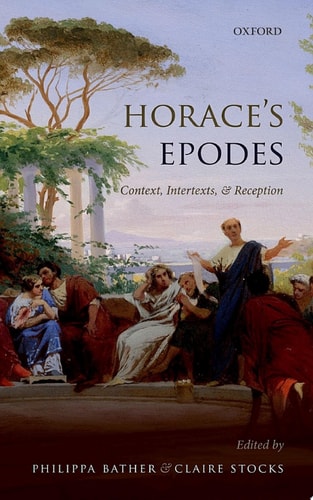
Horace's Epodes: Contexts, Intertexts, and Reception
0
0
As an Amazon Associate and affiliate partner, Menrva Books earns from qualifying purchases. Learn more
Author Description
Horace's Epodes rank among the most under-valued texts of the early Roman principate. Abrasive in style and riddled with apparent inconsistencies, the Epodes have divided critics from the outset, infuriating and delighting them in equal measure. This collection of essays on the Epodes by new and established scholars seeks to overturn this work's ill-famed reputation and to reassert its place as a valid and valued member of Horace's literary corpus. Building upon a recent surge in scholarly interest in the Epodes, the volume goes one step further by looking beyond the collection itself to highlight the importance of intertext, context, and reception. Covering a wide range of topics including the iambic tradition and aspects of gender, it begins with a consideration of the influences of Greek iambic upon the Epodes and ends with a discussion on their reception during the seventeenth century and beyond. By focusing on the connections that can be drawn between the Epodes and other (ancient) works, as well as between the Epodes themselves, the volume will appeal to new and seasoned readers of the poems. In doing so it demonstrates that this smallest, and seemingly most insignificant, of Horace's works is worthy of a place alongside the much-lauded Satires and Odes.
Menrva's Summary
THE THESIS
This volume investigates the historical and literary significance of Horace's Epodes, challenging their long-standing reputation as an inferior component of his corpus. The editors, Claire Stocks and Philippa Bather, curate a collection of essays from various scholars to re-evaluate the text through the lenses of intertextuality, historical context, and long-term reception. By analyzing the poems' relationship to the iambic tradition and their influence on later literature, the contributors argue for a more nuanced appreciation of the work's complexity and artistic merit.
THE SCOPE MAP
What You Will Find
- Analysis of the Greek iambic tradition and its influence on Horace.
- Examination of gender dynamics within the poems.
- Studies on the reception of the Epodes from the seventeenth century to the modern era.
- Comparative analysis between the Epodes and Horace's other works, such as the Satires and Odes.
Scope Limits
- The volume does not provide a line-by-line commentary or a new translation of the poems.
- It focuses primarily on scholarly reception and intertextual connections rather than a comprehensive biographical study of Horace.
THE AUTHORITY PERSPECTIVE
Scholars and students of Latin literature view this collection as a significant contribution to the recent resurgence of interest in Horace's less-studied works. The text is noted for its academic rigor and its success in bridging the gap between traditional philological analysis and modern reception studies.
Page Count:
279
Publication Date:
2016-01-01
Publisher:
Oxford University Press
ISBN-10:
0191808768
ISBN-13:
9780191808760
Poetry
Literary Criticism
Roman History
Academic