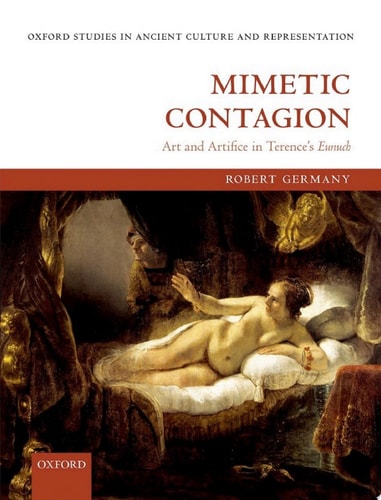
Mimetic Contagion: Art and Artifice in Terence's Eunuch
0
0
As an Amazon Associate and affiliate partner, Menrva Books earns from qualifying purchases. Learn more
Author Description
This volume considers the phenomenon of mimetic contagion, whereby works of art draw viewers into direct imitation of themselves, and how it operates within specific historical contexts. Terence's Eunuch is used as a case study, situating the motif within the peculiarities of mid-second-century BC Rome and its anxieties about the power of art.
Menrva's Summary
THE THESIS
This volume investigates how the concept of mimetic contagion—the process by which art compels viewers to imitate its content—functions as a critical mechanism within the social and political landscape of mid-second-century BC Rome. Robert Germany, a scholar of classical literature, utilizes Terence's play Eunuch as a primary case study to examine the anxieties surrounding the influence of Greek art on Roman identity. By analyzing the intersection of performance and audience reception, the author argues that the play serves as a site for negotiating the perceived dangers of aesthetic absorption.
THE SCOPE MAP
What You Will Find
- Analysis of mimetic theory in the context of Roman reception of Greek culture
- Detailed examination of Terence's Eunuch as a performative text
- Historical contextualization of mid-second-century BC Roman societal anxieties
Scope Limits
- The study focuses primarily on the specific mechanics of Eunuch rather than a broad survey of all Terentian comedies
- The analysis does not extend to the reception of these themes in later post-classical periods
THE AUTHORITY PERSPECTIVE
Scholars in the field of classical studies recognize this work as a rigorous contribution to the study of Roman theatrical reception and cultural history. Readers frequently note the academic density of the prose, which is tailored for researchers and students of ancient drama.
Page Count:
198
Publication Date:
2015-01-01
Publisher:
Oxford University Press
ISBN-10:
0191803014
ISBN-13:
9780191803017
Drama
Roman
Literary Criticism
Art History
Ancient History