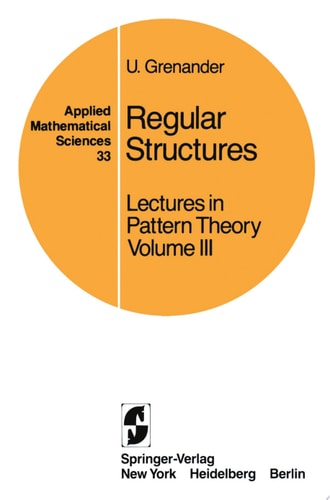
Regular Structures Lectures in Pattern Theory Volume III
0
0
As an Amazon Associate and affiliate partner, Menrva Books earns from qualifying purchases. Learn more
Author Description
Most of the material in this book has been presented in lectures at Brown University, either in courses taught in the Division of Applied Mathematics or in the author's Re search Seminar in Pattern Theory. I would like to thank the several members of the Division of Applied Mathematics that have participated in the discussions and in particular w. Freiberger, S. Geman, C.-R. Hwang, D. McClure and P. Thrift. I would also like to thank F. John, J.P. LaSalle, and L. Sirovich for accepting the manuscript for the Series Applied Mathematical Sciences published by Springer-Verlag. The research reported here has been supported by the National Science Foundation, Office of Naval Research and the Air Force Office of Scientific Research. I am grateful for the active interest and help given in various ways by Dr. Eamon Barrett, Dr. Kent Curtis, Dr. Robert Grafton and Dr. I. Shimi of these agencies. I also thank C.-R. Hwang and P. Thrift for help with proofreading. I am indebted to Mrs. E. Fonseca for her careful pre paration of the manuscript, to Miss E. Addison for helping me with the many diagrams, and to Mrs. K. MacDougall for the final typing of the manuscript. Ulf Grenander Providence, Rhode Island October 1980 v TABLE OF CONTENTS Page INTRODUCTION...
Menrva's Summary
THE THESIS
This volume explores the mathematical framework of regular structures and their application in pattern theory. The book is based on lectures presented at Brown University, drawing from courses in Applied Mathematics and the author's research seminar. It delves into the theoretical underpinnings of structures that exhibit regularity, likely focusing on their mathematical properties and how they can be used to model and analyze patterns in data and systems. The research is supported by major scientific funding agencies, indicating a rigorous and advanced treatment of the subject matter.
THE SCOPE MAP
- Mathematical foundations of regular structures
- Applications in pattern theory and analysis
- Concepts derived from research seminars and university lectures
- Theoretical frameworks for understanding complex patterns
- Mathematical modeling techniques
THE AUTHORITY PERSPECTIVE
The book is presented as a collection of advanced lectures, suggesting a technical and academic audience. The inclusion of acknowledgments from research agencies and specific university departments indicates its grounding in academic research and development. The content likely appeals to mathematicians, computer scientists, and researchers in fields that utilize pattern recognition and analysis.
Page Count:
570
Publication Date:
2012-12-06
Publisher:
Springer Science & Business Media
ISBN-10:
1461259053
ISBN-13:
9781461259053
Science
Non-Fiction
Applied Mathematics
Computer Science
Machine Learning
Mathematics
Community Tags
Similar Books