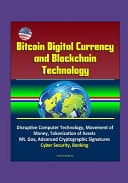
Bitcoin: Digital Currency and Blockchain Technology - Disruptive Computer Technology, Movement of Money, Tokenization of Assets, Mt. Gox, Advanced Cryptographic Signatures, Cyber Security, Banking
0
0
As an Amazon Associate and affiliate partner, Menrva Books earns from qualifying purchases. Learn more
Author Description
Digital currency and blockchain technology has the potential to disrupt a whole host of industries from financial services to manufacturing, supply chain management, and to health care records, by infusing transparency and trust in traditionally closed systems. This is a new technology. The White Paper describing the first public blockchain application, Bitcoin, was published in 2009, and already there has been a billion dollars in capital investment over 1,000 firms, most of which are startup companies. Bitcoin is the best-known digital currency and a good case study for the disruptive nature of the blockchain. The Federal Reserve Bank of Chicago highlighted how Bitcoin's blockchain solves two basic issues with digital currency, by controlling the creation and avoiding its duplication. Bitcoin limits an individual's ability to copy and paste new money files to double spend -- we do that in the Federal Government sometimes -- to double-spend digital wealth through advanced cryptographic signatures. The solution Bitcoin presents to currency may also be applied to other asset cases, including intellectual property, mortgages, and other property records. In a way, it provides a way to create singular possession online, mimicking possession in the physical world, but with a transparent and immutable ledger recording of the possession along the way. While there have been issues through the development and growth of Bitcoin, including some of the Mt. Gox issues, the technology has withstood the stress of growth to date. In the same way that the internet has transformed communications, the adoption of blockchain technology has the potential to disrupt digital asset transfers.
Menrva's Summary
THE THESIS
The advent of digital currency and blockchain technology presents a fundamental challenge to traditional industries by introducing unprecedented transparency and trust into closed systems. This technology, with Bitcoin as a prime example, has rapidly attracted significant investment and is poised to disrupt sectors ranging from finance to healthcare. The core innovation lies in its ability to control the creation of digital assets and prevent duplication, a feat achieved through advanced cryptographic signatures. Beyond currency, blockchain's potential extends to the tokenization of various assets, creating a verifiable and immutable record of ownership online.
THE SCOPE MAP
- An examination of digital currency and blockchain technology's disruptive potential across multiple industries.
- Case study analysis of Bitcoin, including its role in controlling currency creation and preventing double-spending.
- Discussion of advanced cryptographic signatures and their application in securing digital transactions.
- Exploration of tokenization of assets, such as intellectual property, mortgages, and property records.
- Analysis of cybersecurity implications and the role of blockchain in creating singular online possession.
- Consideration of historical issues, including the Mt. Gox incident, and the technology's resilience.
- The potential impact of blockchain technology on digital asset transfers, drawing parallels to the internet's transformation of communications.
THE AUTHORITY PERSPECTIVE
This document, authored by U.S. Congress and the U.S. Government, offers a foundational overview of Bitcoin and blockchain technology. It highlights the technology's disruptive potential and its innovative solutions to digital currency challenges. The text emphasizes the importance of cryptographic signatures and the application of blockchain to asset tokenization. The reception is that of an official, informative report detailing a significant technological shift.
Page Count:
79
Publication Date:
2017-04-19
Publisher:
Amazon Digital Services LLC - KDP Print US
ISBN-10:
1521101558
ISBN-13:
9781521101551
Science & Technology
Economics
Non-Fiction
Blockchain Technology
Cyber Security
Banking
Cryptocurrency
Community Tags
Similar Books









Reader Comments
Share Your Thoughts
No comments yet. Be the first to share your thoughts!