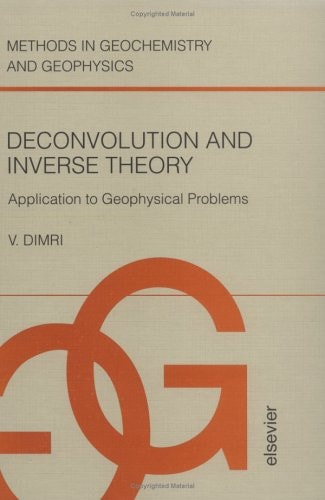
Deconvolution and Inverse Theory: Application to Geophysical Problems
0
0
As an Amazon Associate and affiliate partner, Menrva Books earns from qualifying purchases. Learn more
Author Description
This is the first study to present simultaneously both deconvolution and inversion, two powerful tools of data analysis. Featured within this volume are various geophysical convolution models and a treatment of deconvolution for a time-varying signal. The single channel time-varying deconvolution is shown equivalent to the multichannel time-invariant deconvolution, thus a formalism and associated algorithms can handle both. Inverse theory as well as various inversion schemes are presented on the basis of a relationship between a small perturbation to the model and its effects on the observation. The information theory inversion scheme is discussed, and several types of norm of minimization presented. Additionally, concepts and results of inverse theory are applied to design a new deconvolution operator for estimating magnetization and density distribution, and the constraint of the Backus-Gilbert formalism of inverse theory is used to design a new prediction error filter for maximum entropy spectral estimates. Maximum likelihood, another high resolution method is also presented. This volume can be utilised as a graduate-level text for courses in Geophysics. Some chapters will be of use for graduate courses in Applied Mathematics, Applied Statistics, and Oceanography. Review This little booklet has the potential of becoming a source book on geophysical (de)convolution and inverse theory for years to come. I highly recommend it as well as to the research geophysicist as to the graduate student. Pageoph
Menrva's Summary
THE THESIS
This book addresses the fundamental challenges of deconvolution and inverse theory, presenting them as interconnected tools for data analysis, particularly within geophysical applications. The author, V. Dimri, explores various geophysical convolution models and details deconvolution techniques for time-varying signals, demonstrating their equivalence to multichannel time-invariant deconvolution. The core of the inverse theory presented is based on the relationship between small model perturbations and their observational effects, offering several inversion schemes. The book also delves into information theory inversion, various minimization norms, and applies inverse theory concepts to design new deconvolution operators for estimating magnetization and density distributions, alongside prediction error filters for maximum entropy spectral estimates and maximum likelihood methods.
THE SCOPE MAP
- Treatment of deconvolution for time-varying signals.
- Equivalence of single-channel time-varying deconvolution to multichannel time-invariant deconvolution.
- Formalism and algorithms for handling both time-varying and time-invariant deconvolution.
- Presentation of inverse theory based on the relationship between model perturbations and observational effects.
- Discussion of the information theory inversion scheme.
- Introduction to several types of norm minimization.
- Application of inverse theory to design new deconvolution operators for magnetization and density estimation.
- Design of a new prediction error filter for maximum entropy spectral estimates using Backus-Gilbert formalism.
THE AUTHORITY PERSPECTIVE
This volume is recognized as a significant contribution, potentially serving as a foundational text on geophysical (de)convolution and inverse theory for many years. It is highly recommended for both practicing research geophysicists and graduate students in the field. The book's comprehensive approach to deconvolution and inversion, coupled with its practical applications in geophysics, makes it a valuable resource. Its utility extends to graduate courses in Applied Mathematics, Applied Statistics, and Oceanography, highlighting its interdisciplinary relevance.
Page Count:
230
Publication Date:
2013-01-01
Publisher:
Elsevier Science
ISBN-10:
0444894934
ISBN-13:
9780444894939
Non-Fiction
Science
Data Analysis
Geophysics
Applied Mathematics
Community Tags
Similar Books