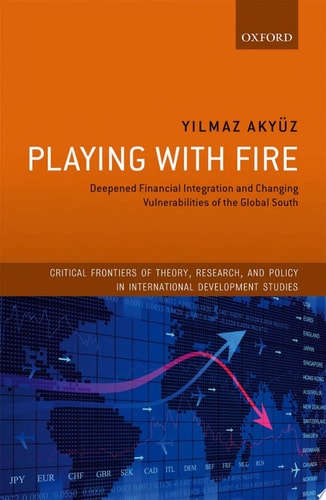
Playing with Fire: Deepened Financial Integration and Changing Vulnerabilities of the Global South
0
0
As an Amazon Associate and affiliate partner, Menrva Books earns from qualifying purchases. Learn more
Author Description
Starting in the early 1990s many emerging and developing economies (EDEs) liberalized their capital accounts, allowing greater freedom for international lenders and investors to enter their markets as well as for their residents to borrow and invest in international financial markets. Despite recurrent crises, liberalization has continued and in fact accelerated in the new millennium. Integration has been greatly facilitated by progressively looser monetary policy in the United States, notably the policies that culminated in debt crises in the United States and Europe and the ultra-easy monetary policy adopted in response. Not only have their traditional cross-border linkages been deepened and external balance sheets expanded rapidly, but also foreign presence in their domestic financial markets and the presence of their nationals in foreign markets have reached unprecedented levels. As a result new channels have emerged for the transmission of financial shocks from global boom-bust cycles. Almost all EDEs are now vulnerable irrespective of their balance-of-payments, external debt, net foreign assets and international reserve positions although these play an important role in the way such shocks could impinge on them. This is a matter for concern since the multilateral system still lacks mechanisms for orderly resolution of financial crises with international dimensions.
Menrva's Summary
THE THESIS
This book investigates how the liberalization of capital accounts in emerging and developing economies (EDEs) has increased their vulnerability to global financial shocks. Author Yılmaz Akyüz, a noted economist specializing in development and international finance, utilizes historical data from the 1990s to the present to analyze the impact of capital account liberalization. He argues that the deepening integration of EDEs into international financial markets, coupled with loose monetary policies in developed nations, has created new, dangerous channels for the transmission of boom-bust cycles that threaten economic stability regardless of a nation's specific balance-of-payments position.
THE SCOPE MAP
What You Will Find
- Analysis of capital account liberalization trends since the 1990s.
- Examination of the relationship between U.S. monetary policy and EDE financial stability.
- Assessment of new transmission channels for global financial shocks.
Scope Limits
- The text does not provide a comprehensive guide for individual investors or corporate financial planning.
- It does not offer a detailed country-by-country case study for every developing nation.
THE AUTHORITY PERSPECTIVE
Experts in international political economy recognize this work as a critical critique of current global financial architecture and the risks inherent in rapid market integration. Readers frequently note the technical density of the prose, which is intended for an audience familiar with macroeconomic theory and international finance policy.
Page Count:
0
Publication Date:
1900-01-01
Publisher:
Oxford University Press
ISBN-10:
0191838667
ISBN-13:
9780191838668
Economics
Finance
International relations