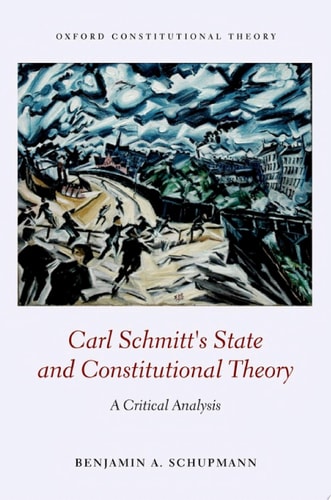
Carl Schmitt's State and Constitutional Theory: A Critical Analysis
0
0
As an Amazon Associate and affiliate partner, Menrva Books earns from qualifying purchases. Learn more
Author Description
Schupmann appraises Schmitt's constitutional theory and examines how it was conceived in response to the Weimar Germany's legitimation crisis. Schmitt's normative theory of 'constrained' democracy offers a novel way to understand the legitimacy of liberal democracy and the limits of constitutional change, and is today more relevant than ever.
Menrva's Summary
THE THESIS
This work investigates whether Carl Schmitt's constitutional theory provides a viable framework for understanding the legitimacy and stability of modern liberal democracies. Benjamin A. Schupmann, a scholar of political theory, utilizes historical analysis of the Weimar Republic to evaluate Schmitt's normative arguments. He argues that Schmitt's concept of 'constrained' democracy offers a specific mechanism for managing constitutional crises and defining the boundaries of political authority.
THE SCOPE MAP
What You Will Find
- Analysis of the Weimar Germany legitimation crisis
- Examination of Schmitt's normative theory of democracy
- Discussion on the limits of constitutional change
- Evaluation of Schmitt's relevance to contemporary political structures
Scope Limits
- Does not provide a comprehensive biography of Carl Schmitt
- Does not focus on Schmitt's later political affiliations or controversial personal history
THE AUTHORITY PERSPECTIVE
Scholars and political theorists frequently cite this text as a rigorous re-evaluation of Schmitt's constitutional contributions, moving beyond his more polarizing political writings. Experts highlight the book's utility for those interested in the intersection of democratic legitimacy and constitutional design.
Page Count:
240
Publication Date:
2017-01-01
Publisher:
Oxford University Press
ISBN-10:
0191833991
ISBN-13:
9780191833991
History
Legal Theory
Political Philosophy
Constitutional Law