Author Description
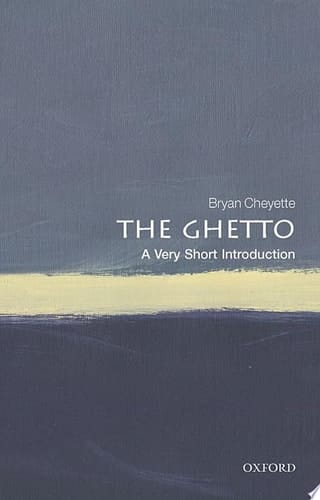
For Three Hundred Years The Ghetto Defined Jewish Culture In The Late Medieval And Early Modern Period In Western Europe. In The Nineteenth-century It Was A Free-floating Concept Which Travelled To Eastern Europe And The United States. Eastern European Ghettos, Which Enabled Genocide, Were Crudely Rehabilitated By The Nazis During World War Two As If They Were Part Of A Benign Medieval Tradition. In The United States, The Word Ghetto Was Routinely Applied To Endemic Black Ghettoization Which Has Lasted From 1920 Until The Present. Outside Of America The Ghetto Has Been Universalized As The Incarnation Of Class Difference, Or Colonialism, Or Apartheid, And Has Been Applied To Segregated Cities And Countries Throughout The World. Why Ghetto? -- The Age Of The Ghetto -- Ghettos Of The Imagination -- Nazism And The Ghetto -- The Ghetto In America -- The Global Ghetto. Bryan Cheyette. Includes Bibliographical References (pages 127-137) And Index.
Menrva's Summary
THE THESIS
This book investigates the historical evolution and semantic transformation of the term 'ghetto' from its origins in early modern Europe to its contemporary global application. Bryan Cheyette, a professor of modern literature and cultural history, utilizes a multidisciplinary framework to trace how the concept shifted from a specific Jewish residential enclosure to a universalized metaphor for segregation, colonialism, and systemic inequality. He argues that the term's history is inextricably linked to shifting power dynamics and the manipulation of historical memory.
THE SCOPE MAP
What You Will Find
- Historical analysis of Jewish ghettos in early modern Western Europe
- Examination of the Nazi appropriation of the ghetto concept during World War II
- Study of the application of the term to Black urban segregation in the United States
- Exploration of the 'global ghetto' as a metaphor for class, colonialism, and apartheid
Scope Limits
- The text does not provide an exhaustive sociological study of every specific modern urban enclave
- It focuses primarily on the conceptual and historical development of the term rather than contemporary policy solutions
THE AUTHORITY PERSPECTIVE
Experts highlight this work as a concise and intellectually rigorous primer on the complex etymology and political usage of the term. Readers frequently note the academic density of the prose, which effectively synthesizes vast historical periods into a compact, accessible format.
Page Count:
0
Publication Date:
1900-01-01
Publisher:
Oxford University Press,
ISBN-10:
0191847208
ISBN-13:
9780191847202
History
Ghettos
Jewish Studies
Sociology
Architecture and Planning
Segregation
Inner Cities
Urban Studies
Jewish ghettos
Ghetto The English word
Community Tags
Similar Books