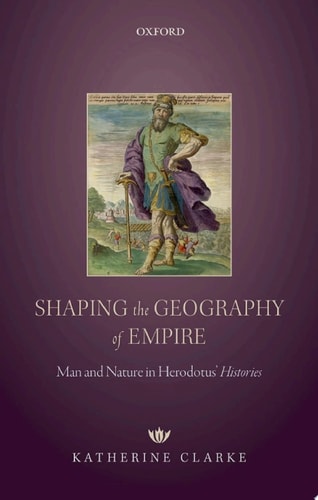
Shaping the Geography of Empire: Man and Nature in Herodotus' Histories
0
0
As an Amazon Associate and affiliate partner, Menrva Books earns from qualifying purchases. Learn more
Author Description
Focusing On The Depiction Of The Natural World In Herodotus' Histories, This Volume Explores The Fluid And Complex Network Of Spatial Relationships That Emerges From His Narrative, Examining Its Significance For The Analysis Of Focalization In The Work And For Understanding The Role Of Geography In The Shaping Of Successive Empires.
Menrva's Summary
THE THESIS
This volume investigates how Herodotus utilizes the natural world and spatial relationships to construct a narrative framework that defines the rise and fall of empires. Katherine Clarke, a scholar of ancient history, examines the intersection of geography and political power within the Histories, arguing that the physical environment is not merely a backdrop but an active participant in the historical process. By analyzing Herodotus' descriptions of landscapes, rivers, and islands, the author demonstrates how spatial focalization shapes the reader's understanding of imperial expansion and cultural identity.
THE SCOPE MAP
What You Will Find
- Analysis of Herodotus' narrative techniques regarding space and place
- Examination of geographical features as metaphors for political and moral control
- Exploration of the relationship between human movement and the natural environment
Scope Limits
- The study focuses primarily on the Histories rather than a comprehensive survey of all ancient Greek geographical writing
- It does not provide a general biography of Herodotus or a complete historical account of the Persian Wars
THE AUTHORITY PERSPECTIVE
Scholars recognize this work as a significant contribution to the study of ancient historiography and the spatial turn in classical research. Readers frequently note the academic density of the prose, which is intended for those with a background in classical literature or historical theory.
Page Count:
0
Publication Date:
1900-01-01
Publisher:
Oxford University Press,
ISBN-10:
0191860271
ISBN-13:
9780191860270
History
Knowledge
Ancient Greece
Herodotus
Literary Criticism
Historical geography
Geography
Geography Ancient
In literature
Classical geography