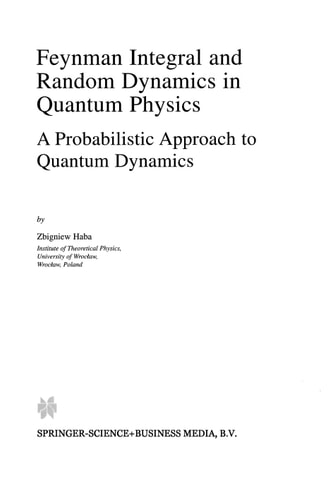
Feynman Integral and Random Dynamics in Quantum Physics
0
0
As an Amazon Associate and affiliate partner, Menrva Books earns from qualifying purchases. Learn more
Author Description
The Feynman integral is considered as an intuitive representation of quantum mechanics showing the complex quantum phenomena in a language comprehensible at a classical level. It suggests that the quantum transition amplitude arises from classical mechanics by an average over various interfering paths. The classical picture suggested by the Feynman integral may be illusory. By most physicists the path integral is usually treated as a convenient formal mathematical tool for a quick derivation of useful approximations in quantum mechanics. Results obtained in the formalism of Feynman integrals receive a mathematical justification by means of other (usually much harder) methods. In such a case the rigour is achieved at the cost of losing the intuitive classical insight. The aim of this book is to formulate a mathematical theory of the Feynman integral literally in the way it was expressed by Feynman, at the cost of complexifying the configuration space. In such a case the Feynman integral can be expressed by a probability measure. The equations of quantum mechanics can be formulated as equations of random classical mechanics on a complex configuration space. The opportunity of computer simulations shows an immediate advantage of such a formulation. A mathematical formulation of the Feynman integral should not be considered solely as an academic question of mathematical rigour in theoretical physics.
Menrva's Summary
THE THESIS
This book investigates the mathematical formulation of the Feynman integral by complexifying the configuration space to express it as a probability measure. The author, Z. Haba, aims to present a rigorous mathematical theory of the Feynman integral that aligns with Feynman's original intuitive concept, which is often lost when treated solely as a formal tool. The work explores how quantum mechanics equations can be reformulated as equations of random classical mechanics on this complex configuration space, offering potential advantages for computer simulations. This approach seeks to bridge the gap between the intuitive classical insight of path integrals and the mathematical rigor required in theoretical physics.
THE SCOPE MAP
- A detailed exploration of the Feynman integral as a representation of quantum mechanics.
- Formulation of quantum mechanics equations as random classical mechanics on a complex configuration space.
- Discussion of the intuitive classical insight versus mathematical rigor in path integral treatments.
- Potential applications and advantages for computer simulations of quantum phenomena.
- Mathematical theory of the Feynman integral presented in a manner close to Feynman's original expression.
THE AUTHORITY PERSPECTIVE
The book presents a specialized mathematical approach to the Feynman integral, aiming to provide a rigorous formulation that retains Feynman's intuitive classical perspective. By complexifying the configuration space, it seeks to express the integral as a probability measure, thereby recasting quantum mechanics in terms of random classical mechanics. This perspective offers potential benefits for computational physics, suggesting that the mathematical treatment of path integrals can yield both rigor and intuitive understanding. The work is positioned as a contribution to theoretical physics that bridges formal mathematical tools with conceptual clarity.
Page Count:
367
Publication Date:
2013-03-11
Publisher:
Springer Nature
ISBN-10:
9401147167
ISBN-13:
9789401147163
Non-Fiction
Science
Path Integrals
Theoretical Physics
Mathematical Physics
Community Tags
Similar Books