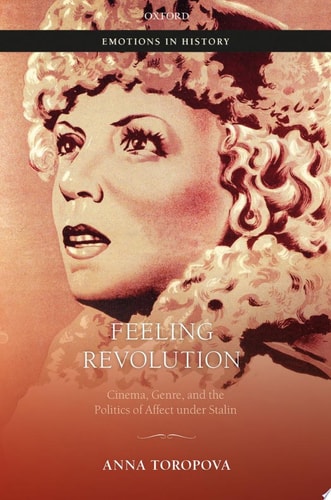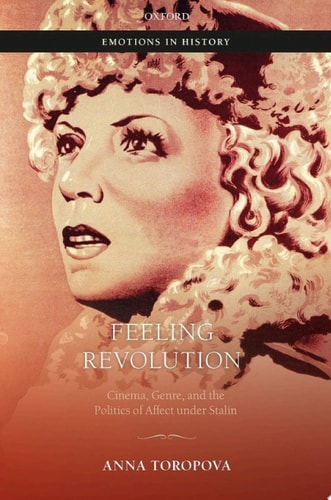
Feeling Revolution: Cinema, Genre, And The Politics Of Affect Under Stalin
0
0
As an Amazon Associate and affiliate partner, Menrva Books earns from qualifying purchases. Learn more
Author Description
Cover -- Feeling Revolution -- Copyright -- Dedication -- Acknowledgements -- Contents -- List Of Illustrations -- Glossary And Abbreviations -- Note On Transliteration -- Introduction -- Genre And Rivalling Hollywood -- Emotional Meanings -- Theorizing Affect -- 1 Emotional Education -- Re-evaluating Feeling: The Rise Of A Developmental Conception Of Emotion -- Probing The Emotions Of The Spectator -- Genres Of Feeling -- Audience Guidance -- Thematic Planning: Genre Film 'soviet Style' -- 2 'if We Cannot Laugh Like That, Then How Can We Laugh?' The 'problem' Of Stalinist Film Comedy Learning To Laugh In A Different Way -- Cheerful Comedy -- 'the Most Underdeveloped Part Of Soviet Cinematography' -- 'laughing Through Tears' -- The 'laughter Of Victors' -- An 'impossible' Genre -- Conclusion -- 3 Learning To Hate Paranoia And Abjection In The Stalinist Thriller -- The Conspiracy Thriller's Return -- Abject Thrills -- Polarizing 'us' And 'them' During The Cold War -- The 'dark Turn' In Soviet Cinema -- Closer To The Enemy -- Conclusion -- 4 Manufacturing Happiness The Production Film And The Heroic Biography In The Era Of 'care For The Person' Happiness, Labour, And The Stalin-era Production Film -- A New Type Of Politics: Sergei Iutkevich's Miners And Dziga Vertov's Lullaby -- The Heroic Biography: Mikhail Kalatozov's Valerii Chkalov -- Re-asserting 'the Happiness Of Sacrifice' In The Post-war Period -- Conclusion -- 5 Pathos, Powerlessness, And The Persistence Of The Melodramatic Mode -- The 'happy Ending' Drama Of Everyday Life -- Melodrama In The Guise Of Literary Adaptation -- Stalinist Gothic: Sergei Gerasimov's Masquerade -- Melodrama At War -- The Zhdanovshchina And The 'waning Of Affect' -- Conclusion Epilogue Formless Feeling -- Bibliography -- I. Archives -- Ii. Journals And Newspapers -- Iii. Films -- Iv. Published Primary Sources And Document Collections -- V. Secondary Sources And Theoretical Works -- Index Anna Toropova. Electronic Reproduction. Oxford
Menrva's Summary
THE THESIS
This book investigates how Stalinist cinema functioned as a mechanism for emotional engineering, shaping the affective lives of Soviet citizens to align with state ideology. Anna Toropova, a scholar of Russian cinema and culture, utilizes archival documents, contemporary journals, and film analysis to argue that genre conventions were not merely aesthetic choices but political tools. By examining the intersection of film theory and state-mandated emotional expression, the author demonstrates how the Soviet film industry sought to standardize the feelings of the populace during the Stalin era.
THE SCOPE MAP
What You Will Find
- Analysis of specific genres including comedy, the thriller, the production film, and the heroic biography.
- Theoretical frameworks regarding the 'developmental conception' of emotion in Soviet society.
- Examination of the transition from early revolutionary ideals to the rigid emotional control of the post-war period.
Scope Limits
- The study focuses primarily on the Stalinist period and does not provide an exhaustive history of Soviet cinema post-1953.
- It does not cover the technical production aspects of filmmaking, focusing instead on the political and psychological intent behind the narratives.
THE AUTHORITY PERSPECTIVE
Scholars in the field of Slavic studies and film history identify this work as a rigorous examination of the intersection between state power and mass media. Readers frequently note the academic density of the prose, which provides a detailed look at how cinema was used to manufacture specific social responses.
Page Count:
0
Publication Date:
1900-01-01
Publisher:
Oxford University Press,
ISBN-10:
0191869058
ISBN-13:
9780191869051
History
Film Studies
Motion pictures
Soviet History
Media Theory
Community Tags
Similar Books