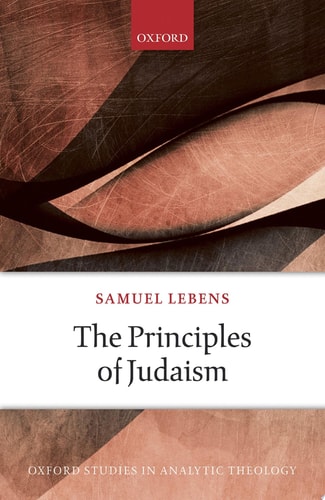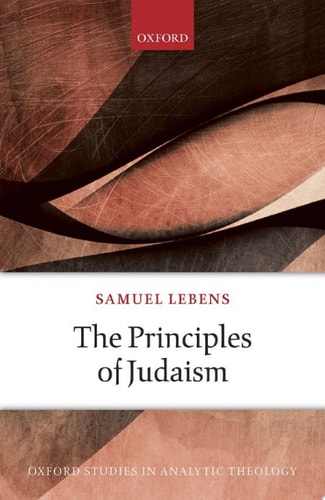
The Principles Of Judaism
0
0
As an Amazon Associate and affiliate partner, Menrva Books earns from qualifying purchases. Learn more
Author Description
Cover -- The Principles Of Judaism -- Copyright -- Dediction -- Preface -- Acknowledgements -- Contents -- 1 Introduction: Avoiding A Paradoxical Preface -- 1.1. Introducing The Principles -- 1.2. A Paradoxical Preface -- 1.3. The Apophaticism Of Saadya Gaon And Maimonides -- 1.4. Religious Experience -- 1.5. Route 1: True Contradictions -- 1.6. Route 2: Non-fundamental Truth -- 1.7. Route 3: The Tractatus -- 1.7.1. Apophaticism As Illuminating Falsehood -- 1.7.2. Therapeutic Falsehood -- 1.7.2.1. Fallibilism And The Preface -- Part I Creation -- 2 Creatio Ex Nihilo 2.1. The Doctrine Of Creatio Continua -- 2.1.1. Philosophical Considerations -- 2.1.1.1. The Argument From The Nature Of Matter -- 2.1.1.2. The Argument From The Concept Of Possibility -- 2.1.1.3. The Argument From The Nature Of Time -- 2.1.1.4. The Argument From God's Rationality -- 2.1.1.5. The Argument From God's Immutability -- 2.1.1.6. Arguments From Perfection P -- 2.1.1.7. A New Argument From Permanentism -- 2.1.1.8. Freedom And Eternity -- 2.1.2. Cosmological Considerations -- 2.1.3. Biblical And Traditional Considerations -- 2.2. The Beginning Of Time 2.2.1. Cosmological Considerations For The Beginning Of Time -- 2.2.2. Philosophical Considerations For The Beginning Of Time -- 2.3. Ex Nihilo Or Ex Materia? -- 2.3.1. Creation According To Gersonides -- 2.3.2. The Gersonidean Dilemma -- 3 Idealism Ex Nihilo -- 3.1. Berkeley, Better, Besht -- 3.2. From Theism To Idealism -- 3.2.1. Argument 1: From Omnipotence -- 3.2.2. Argument 2: From God's Perfect Rationality -- 3.2.3. Argument 3: From God's Goodness, And Rationality -- 3.3. Tzimtzum And The Problem Of Creation -- 3.4. Non-literal Tzimtzum -- 3.5. A Gersonidean Problem Of Creation 4 Hassidic Idealism Responding To Problems -- 4.1. Problems With Hassidic Idealism -- 4.2. Response To Problem One: Free Will -- 4.2.1. The Meaning Of Freedom -- 4.3. Response To Problem Two: Ontological Significance -- 4.4. Response To Problem Three: Evil -- 4.5. Resp
Menrva's Summary
THE THESIS
This work investigates the philosophical coherence of core Jewish theological doctrines by examining whether traditional religious claims can be reconciled with rigorous analytical logic. Samuel Lebens, a philosopher specializing in the intersection of analytic philosophy and Jewish thought, utilizes a framework that balances classical rabbinic sources with contemporary metaphysical inquiry. He argues that certain theological paradoxes are not merely obstacles to faith but are essential components of a sophisticated, non-literal understanding of divine creation and existence.
THE SCOPE MAP
What You Will Find
- Philosophical analysis of Creatio ex nihilo and Creatio continua.
- Comparative study of Maimonidean apophaticism and Hassidic idealism.
- Logical frameworks for reconciling divine omnipotence with human free will and the existence of evil.
- Evaluation of Gersonidean cosmology and its implications for modern theism.
Scope Limits
- The text focuses primarily on metaphysical and ontological questions rather than historical or sociological developments within Judaism.
- It does not provide a comprehensive survey of all Jewish denominations or legalistic (Halakhic) practices.
THE AUTHORITY PERSPECTIVE
Scholars and students of Jewish philosophy frequently note the high level of analytical density in the prose, which requires a strong background in both metaphysics and classical Jewish texts. Experts highlight this as a significant contribution to the field of analytic theology, particularly for its attempt to bridge the gap between traditional religious dogma and contemporary philosophical rigor.
Page Count:
0
Publication Date:
1900-01-01
Publisher:
Oxford University Press,
ISBN-10:
0191879096
ISBN-13:
9780191879098
Religion
Philosophy
Judaism and philosophy
Jewish philosophy
Judaism
Metaphysics
Theology
Community Tags
Similar Books