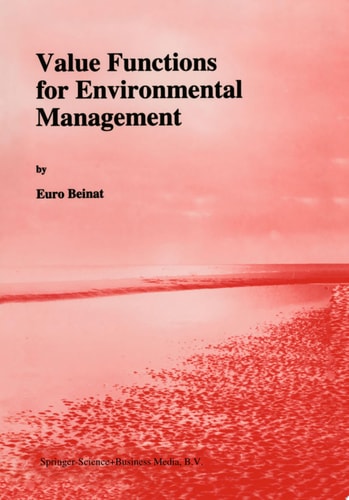
Value Functions for Environmental Management
0
0
As an Amazon Associate and affiliate partner, Menrva Books earns from qualifying purchases. Learn more
Author Description
Environmental decisions must satisfy a multitude of objectives and the matching of a plan, policy or project to such objectives is a matter of both facts and value judgements. Value Functions for Environmental Management provides a systematic approach to the structuring and measurement of value judgements, showing how they drive the decision process and how to make them transparent and effective in support of complex decisions. The value functions that the book describes provide a scheme for the exploration of human values and a tool for transforming them into an analytical model. A clear statement can then be made of the degree to which a decision has achieved its objectives, and how conflicting objectives may be addressed. This does not mean that there is no role for human judgement in the process. Complexity, often coupled with large information gaps, necessitates expert judgement, but the values adopted by the experts are themselves capable of being structured and measured according to the value function methodology presented here, even if the judgements themselves are qualitative and tentative. Value models for expert panels are also presented. The use of the methodology in practice is illustrated by examples. The book contains an extensive subject index.
Menrva's Summary
THE THESIS
Environmental decisions require a systematic approach to reconcile multiple objectives and subjective value judgments. This book presents a methodology for structuring and measuring these value judgments, demonstrating how they influence decision-making processes and can be made transparent and effective. The core of the approach lies in value functions, which serve as a framework for exploring human values and transforming them into analytical models. This allows for a clear assessment of how well decisions meet objectives and how to manage conflicting goals, even when expert judgment is qualitative and tentative.
THE SCOPE MAP
- A systematic approach to structuring and measuring value judgments in environmental management.
- Explanation of how value functions drive decision processes and make them transparent.
- A scheme for exploring human values and transforming them into analytical models.
- Methods for assessing decision achievement against objectives and addressing conflicting goals.
- Value models specifically designed for expert panels.
- Practical illustrations of the methodology through real-world examples.
- An extensive subject index for easy reference.
THE AUTHORITY PERSPECTIVE
The book is regarded as a rigorous academic text that provides a structured methodology for complex decision-making in environmental management. Its approach to quantifying subjective value judgments is noted for its analytical depth, offering a tool for both individual decision-makers and expert panels. The inclusion of practical examples aims to bridge the gap between theoretical frameworks and real-world application, suggesting its utility for practitioners and researchers alike. The methodology presented is designed to enhance the transparency and effectiveness of environmental decision processes.
Page Count:
242
Publication Date:
2013-04-18
Publisher:
Springer Science & Business Media
ISBN-10:
9401588856
ISBN-13:
9789401588850
Science
Non-Fiction
Business
Value Theory
Decision Analysis
Expert Systems
Community Tags
Similar Books