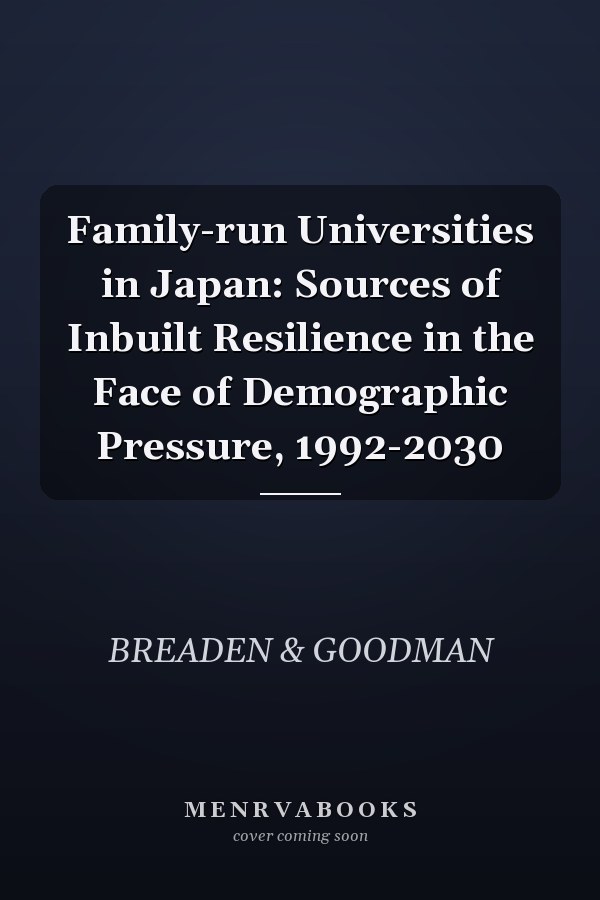
Family-run Universities in Japan: Sources of Inbuilt Resilience in the Face of Demographic Pressure, 1992-2030
0
0
As an Amazon Associate and affiliate partner, Menrva Books earns from qualifying purchases. Learn more
Author Description
In Japan, almost 80% of university students attend private institutions, up to 40% of which are family businesses. This book offers a detailed historical, sociological, and ethnographic analysis of this important category of private university, and examines how institutions have negotiated a period of major demographic decline since the 1990s.
Menrva's Summary
THE THESIS
This book investigates how family-run private universities in Japan maintain institutional stability and resilience amidst a significant national demographic decline. The authors, Jeremy Breaden and Roger Goodman, utilize a combination of historical analysis, sociological theory, and ethnographic fieldwork to examine the governance structures of these unique academic entities. They argue that the family-business model provides specific organizational advantages that allow these institutions to adapt to shrinking student populations and shifting market pressures.
THE SCOPE MAP
What You Will Find
- Historical analysis of the Japanese private higher education sector from 1992 to 2030.
- Sociological framework for understanding family-run organizations in an academic context.
- Ethnographic case studies of specific private university management practices.
- Data regarding the prevalence of family-owned institutions within the Japanese university system.
Scope Limits
- The study does not focus on public or state-funded universities.
- The analysis does not provide a comprehensive guide for international university management strategies.
THE AUTHORITY PERSPECTIVE
Experts recognize this work as a significant contribution to the study of Japanese higher education and organizational resilience. Readers frequently note the academic density of the prose and the depth of the institutional analysis provided by the authors.
Page Count:
0
Publication Date:
1900-01-01
Publisher:
Oxford University Press
ISBN-10:
0191895865
ISBN-13:
9780191895869
Sociology
Education
Demography
Japan
Higher Education
Business History
Community Tags
Similar Books