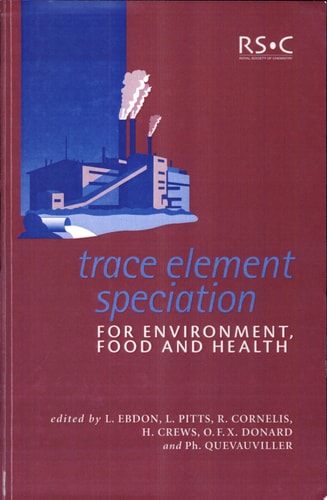
Trace Element Speciation for Environment, Food and Health
0
0
As an Amazon Associate and affiliate partner, Menrva Books earns from qualifying purchases. Learn more
Author Description
The ongoing progress of science has shown that it is important for analytical scientists to determine not only the presence of particular elements, but also their species. There are many fields where this is applicable, and where there are a number of topics to be addressed. Developing separation and measurement systems for the many element species has tested the resourcefulness of analytical chemists over recent decades. A product of the EU sponsored Speciation 21 Network, this book presents a detailed review of the state-of-the-art of speciation issues in the occupational health, food and environment sectors, along with the main conclusions arising from discussions held during expert meetings. Topics covered include mercury and organotin compounds in the environment; factors affecting the health of workers; the importance of speciation of trace elements for health, and subsequent metabolism in the body; analytical methodologies; risk assessment; and legislation. Trace Element Speciation for Environment, Food and Health provides an insight into applied research in the speciation field and how it has become so important in all the fields represented. With its comprehensive coverage, it will be of particular interest to researchers in industry and academia, as well as government agencies and legislative bodies.
Menrva's Summary
THE THESIS
The central problem addressed is the critical need to identify not just the presence of elements, but their specific chemical forms (speciation) across various scientific disciplines. The book reviews the state-of-the-art in speciation analysis, driven by the resourcefulness of analytical chemists in developing separation and measurement systems. It covers key areas such as mercury and organotin compounds in the environment, factors affecting worker health, the role of trace element speciation in human health and metabolism, and the methodologies used for analysis. The work also delves into risk assessment and relevant legislation, providing insights into applied research in this vital field.
THE SCOPE MAP
- Review of speciation issues in occupational health, food, and environmental sectors.
- Detailed discussion on mercury and organotin compounds in the environment.
- Analysis of factors affecting worker health.
- Exploration of the importance of trace element speciation for human health and metabolism.
- Overview of analytical methodologies for speciation.
- Consideration of risk assessment and legislation related to trace elements.
THE AUTHORITY PERSPECTIVE
The book is presented as a product of the EU sponsored Speciation 21 Network, indicating a collaborative and research-driven origin. Its comprehensive coverage of applied research in speciation is intended to be of particular interest to researchers in industry and academia, as well as government agencies and legislative bodies. The text aims to provide an insight into how speciation analysis has become increasingly important across environmental, food, and health sectors. The focus on state-of-the-art reviews and expert discussions suggests a detailed and authoritative resource for specialists in the field.
Page Count:
391
Publication Date:
2001-01-01
Publisher:
Royal Society of Chemistry
ISBN-10:
0854044590
ISBN-13:
9780854044597
Health
Non-Fiction
Science
Food Science
Trace elements
Occupational Health
Analytical Chemistry
Community Tags
Similar Books