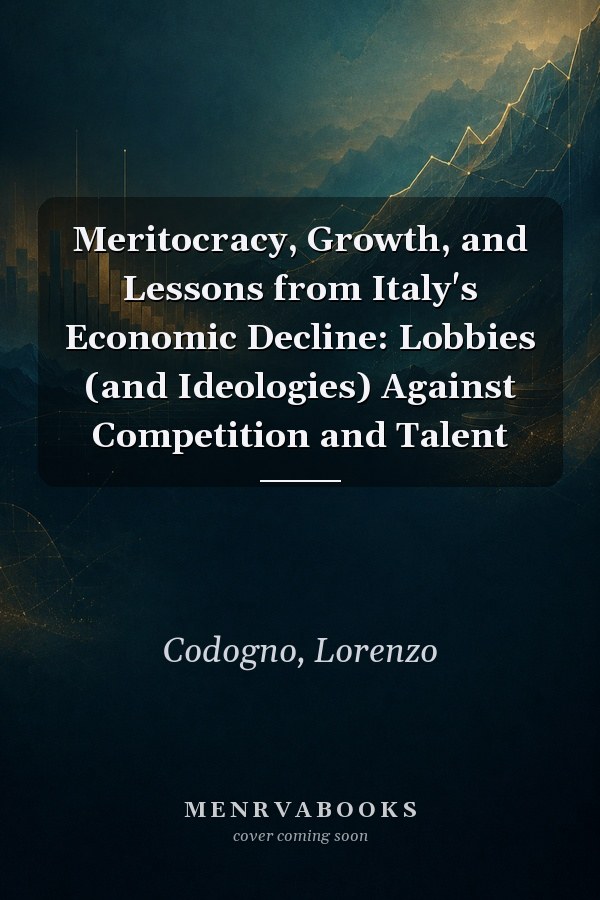
Meritocracy, Growth, and Lessons from Italy's Economic Decline: Lobbies (and Ideologies) Against Competition and Talent
0
0
As an Amazon Associate and affiliate partner, Menrva Books earns from qualifying purchases. Learn more
Author Description
Cover -- Half Title -- Title Page -- Copyright Page -- Preface -- Acknowledgements -- Contents -- List Of Figures -- List Of Tables -- Introduction: Why A Book In English On Italy's Decline? -- Part I Meritocracy And Decline -- 1. In A Nutshell -- 1.1 What Is Meritocracy? -- 1.2 Meritocracy And Equality Of Opportunity -- 1.3 The Enemies Of Meritocracy: Vested Interests And Lobbies -- 1.4 Meritocracy And Moral Standards -- 1.5 Why Did Growth Stall In Italy? -- 1.6 Meritocracy Versus Connections And Lobbies -- 1.7 Historical Legacies And Social Capital 1.8 The Interplay Of Social Capital And Meritocracy -- 1.9 Egalitarianism And The 'long '68' -- 1.10 The 1975 Wage Indexation Accord, Inflation, And Debt -- 2. Italy's Decline: Stylised Facts -- 2.1 Half A Century Of Crises -- 2.2 The 1970s: Inflation -- 2.3 The 1980s: Public Debt -- 2.4 The 1990s: Crisis And Hope -- 2.5 The New Millennium: The Two Original Sins -- 2.6 From The Gfc And The Sovereign Debt Crisis To Ngeu -- 2.7 Italy, The Sick Nation Of The Advanced World -- 2.8 The Facts About Growth And Productivity -- 2.9 Why Low Productivity? -- 2.10 Facts About The Debt And The Budget 2.11 Methodology -- 2.12 The Prosperity Index -- 2.13 Appropriate Use Of International Rankings -- 2.14 Italy's Ranking -- Part Ii Comparative Evidence: Society -- 3. Legacies Of A Troubled History -- 3.1 Low Mutual Trust -- 3.2 Historical Legacy And Trust -- 3.3 Democratic Legitimacy And Meritocracy -- 3.4 Some Unpleasant Truths About Smes -- 4. Lobbies In Government -- 4.1 Trust And Governance -- 4.2 Difficult Transitions Of Power: Berlusconi And The 'red Togas' -- 4.3 The Rise And Fall Of Populism -- 4.4 The Government, Ubiquitous And Untraceable -- 4.5 Lobbying By Rule-makers 4.6 Attempts At Institutional Reforms -- 4.7 Powerful Lobbies: Magistrates -- 4.8 Is Italy Corrupt? -- 5. Lobbies In Education -- 5.1 Low Level Of Education -- 5.2 Egalitarianism For Whom? -- 5.3 Funding Of Universities -- 5.4 Ranking Of Universities -- 5.5 Att
Menrva's Summary
THE THESIS
This book investigates the structural causes of Italy's prolonged economic stagnation by examining the interplay between meritocracy, institutional lobbying, and historical social dynamics. Authors Lorenzo Codogno and Giampaolo Galli, both experienced economists and policy analysts, utilize historical data and comparative international metrics to argue that a lack of competitive meritocracy, driven by entrenched vested interests, has stifled productivity and growth. They provide a framework that links Italy's low social capital and political lobbying to its failure to adapt to modern global economic pressures.
THE SCOPE MAP
What You Will Find
- Historical analysis of Italy's economic performance from the 1970s through the post-GFC era.
- A comparative study of institutional trust and the influence of lobbies in government and education.
- Quantitative data regarding productivity, public debt, and the prosperity index.
Scope Limits
- The analysis focuses primarily on the Italian context and does not provide a comprehensive global economic policy manual.
- The text does not offer specific legislative blueprints for immediate reform but rather identifies the systemic barriers to change.
THE AUTHORITY PERSPECTIVE
Experts recognize this work as a rigorous diagnostic tool for understanding the structural rigidities within the Italian political economy. Readers frequently note the academic density of the prose, which is well-suited for policy analysts and students of European economic history.
Page Count:
0
Publication Date:
1900-01-01
Publisher:
Oxford University Press,
ISBN-10:
0191957739
ISBN-13:
9780191957734
Economics
Sociology
Economic History
Italy
Public Policy
Community Tags
Similar Books










Reader Comments
Share Your Thoughts
No comments yet. Be the first to share your thoughts!