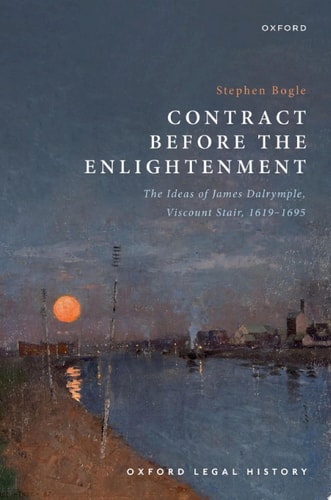
Contract Before The Enlightenment: The Ideas Of James Dalrymple, Viscount Stair, 1619-1695
0
0
As an Amazon Associate and affiliate partner, Menrva Books earns from qualifying purchases. Learn more
Author Description
This Study Explains The Development And Reception Of Viscount Stair’s Innovative Contractual Ideas. By Considering His Philosophical And Theological Impulses This Examination Sheds New Light Upon What Shaped His Legal Thought And Shows The Imprint Of Aristotelianism, Grotius, And Calvin Upon Legal Thought In Scotland. It Explains How Stair Broke New Ground Within The Roman Law Tradition By Assimilating It With Protestant Natural Law. Importantly, This Investigation Demonstrates How Stair’s Calvinist Alteration Of Grotius’ Natural Law Theory Resulted In A Unique Viewpoint In Comparison To His Contemporaries: Bare Agreements And Promises Are Binding; The Human Will Is The Central Trigger For Creation Of Contractual Obligations; Man Has A God-given Freedom By Which To Create Contractual Obligations That He Should Use To Bring Glory To God; And That The Rules Of Contract Should Be Informed By The Needs Of Commerce As Much As Equity. It Concludes By Arguing That Once The Calvinist Theistic Premises Of Stair’s Contractual Thought Are Dropped His Approach Bears The Hallmarks Of The Natural Law Jurisprudence Adopted By Many Of The Leading Moral Philosophers Of Eighteenth-century Scotland.-- Stephen Bogle.
Menrva's Summary
THE THESIS
This study investigates the intellectual origins and theological foundations of Viscount Stair’s contractual theories within the context of seventeenth-century Scottish legal thought. Dr. Stephen Bogle examines how Stair synthesized Roman law traditions with Protestant natural law to create a distinct framework for contractual obligations. By analyzing the influence of Aristotelianism, Grotius, and Calvinism, the author demonstrates how Stair’s unique theological premises shaped the development of modern legal concepts regarding human will and commercial equity.
THE SCOPE MAP
What You Will Find
- An analysis of the intersection between Calvinist theology and natural law jurisprudence.
- A detailed examination of the intellectual influences of Grotius and Aristotelianism on Scottish legal thought.
- A historical reconstruction of the evolution of contract law from the seventeenth century to the eighteenth-century Scottish Enlightenment.
Scope Limits
- This work does not provide a comprehensive biography of James Dalrymple beyond his legal and philosophical contributions.
- The analysis does not extend to the practical application of these legal theories in modern contemporary court systems.
THE AUTHORITY PERSPECTIVE
Scholars in legal history recognize this text as a rigorous examination of the theological underpinnings of Scottish jurisprudence. Experts frequently note the academic density of the prose, which serves as a specialized resource for those studying the transition from early modern natural law to Enlightenment moral philosophy.
Page Count:
0
Publication Date:
1900-01-01
Publisher:
Oxford University Press,
ISBN-10:
0191980552
ISBN-13:
9780191980558
Philosophy
Jurisprudence
Contracts
Contract law
Legal History
Scottish History
Theology