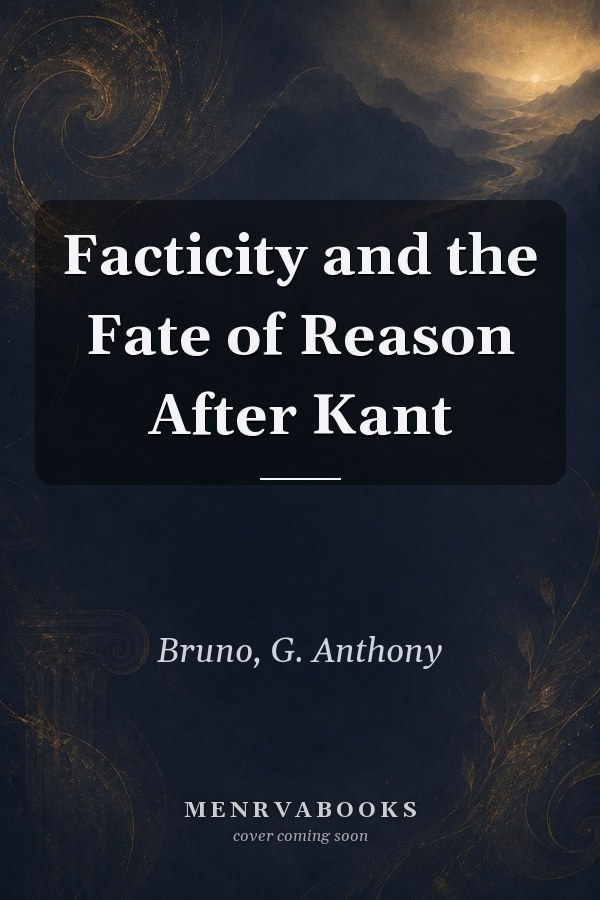
Facticity and the Fate of Reason After Kant
0
0
As an Amazon Associate and affiliate partner, Menrva Books earns from qualifying purchases. Learn more
Author Description
Facticity And The Fate Of Reason After Kant Is The First History Of The Concept Of Facticity. G. Anthony Bruno Argues That This Concept's Coining, Transmission, And Repurposing By Major Thinkers After Kant Leaves A Deep And Lasting Divide Concerning The Post-kantian Question Of Whether A Science Of Intelligibility Can Tolerate Brute Facts. Facticity Is Associated With Phenomenology, For Which The Concept Denotes Undeducibly Brute Conditions Of Intelligibility Like Sociality, Mortality, And Temporality. While This Suggests An Affirmative Answer To The Post-kantian Question, Facticity Originates With German Idealism, Whose Proponents Give A Negative Answer. Fichte Coins Facticity To Denote The Intolerable Bruteness, Radical Contingency, Or Groundlessness Of Conditions Putatively Presupposed By, And Hence Limitations On, Reason. A Science Of Intelligibility Must Eliminate Bruteness To Be Systematic, As Fichte Says, Or Presuppositionless, As Hegel Says. Moreover, Eliminating Bruteness Requires A New Logic For Deducing Conditions Of Intelligibility From Reason's Self-contradictions, A Dialectical Logic Fichte Invents And Hegel Develops. German Idealism's Logical Revolution Provokes Heidegger's Phenomenological Objection That Dialectic Ineluctably Presupposes Factical Conditions Of Lived Experience, Which Must Be Interpreted Hermeneutically. The Untold History Of Facticity Thus Contains The Deepest Parting Of The Ways After Kant. On The One Hand, Hegel Eliminates Vestigial Facticity In Fichte's System By Pursuing A Presuppositionless Science Of Intelligibility, Although Schelling Charges Hegel With Presupposing That Science's Value And The Existence It Renders Intelligible. On The Other Hand, Lask's Otherwise Misleading Neo-kantian Reading Of Fichte's Neologism Inspires Heidegger To Reject Presuppositionlessness For A Hermeneutics Of Facticity. The Trajectory From German Idealism To Phenomenology Is Accordingly One In Which Facticity Initially Impedes The Science Of Intel
Menrva's Summary
THE THESIS
This book investigates whether a science of intelligibility can accommodate brute facts by tracing the historical development and conceptual shifts of 'facticity' from German Idealism to phenomenology. G. Anthony Bruno, a scholar of post-Kantian philosophy, examines how the term was coined by Fichte to denote intolerable contingency and subsequently repurposed by thinkers like Hegel, Schelling, Lask, and Heidegger. The work argues that the evolution of this concept reveals a fundamental divide in post-Kantian thought regarding the possibility of a presuppositionless system of reason.
THE SCOPE MAP
What You Will Find
- A historical analysis of the concept of facticity from its origin in Fichtean idealism to its role in Heideggerian phenomenology.
- An examination of the dialectical logic developed by Fichte and Hegel to eliminate bruteness from philosophical systems.
- A study of the hermeneutic turn in phenomenology as a response to the perceived failures of German Idealism.
Scope Limits
- The text focuses specifically on the lineage of the term 'facticity' and does not provide a comprehensive survey of all post-Kantian metaphysical developments.
THE AUTHORITY PERSPECTIVE
Scholars recognize this text as a rigorous historical reconstruction of a previously under-examined philosophical concept. Readers frequently note the academic density of the prose, which requires a strong background in German Idealism and phenomenological terminology to navigate effectively.
Page Count:
0
Publication Date:
2024-01-01
Publisher:
New York : Oxford University Press,
ISBN-10:
0191987530
ISBN-13:
9780191987533
Philosophy
Philosophy history
Epistemology
Phenomenology
Community Tags
Similar Books