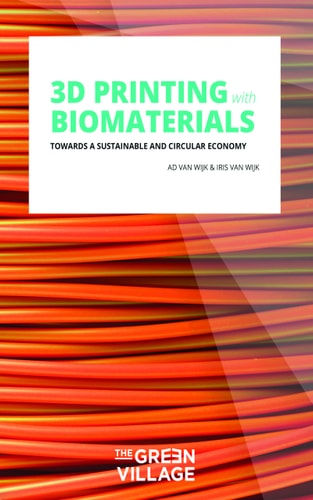
3D Printing with Biomaterials Towards a Sustainable and Circular Economy
0
0
As an Amazon Associate and affiliate partner, Menrva Books earns from qualifying purchases. Learn more
Author Description
Additive manufacturing or 3D printing, manufacturing a product layer by layer, offers large design freedom and faster product development cycles, as well as low startup cost of production, on-demand production and local production. In principle, any product could be made by additive manufacturing. Even food and living organic cells can be printed. We can create, design and manufacture what we want at the location we want. 3D printing will create a revolution in manufacturing, a real paradigm change.3D printing holds the promise to manufacture with less waste and energy. We can print metals, ceramics, sand, synthetic materials such as plastics, food or living cells. However, the production of plastics is nowadays based on fossil fuels. And that's where we witness a paradigm change too. The production of these synthetic materials can be based also on biomaterials with biomass as feedstock.A wealth of new and innovative products are emerging when we combine these two paradigm changes: 3D printing and biomaterials. Moreover, the combination of 3D printing with biomaterials holds the promise to realize a truly sustainable and circular economy.
Menrva's Summary
THE THESIS
This book investigates the transformative potential of combining 3D printing with biomaterials to foster a sustainable and circular economy. The authors, Ad van Wijk and Iris van Wijk, explore how additive manufacturing, with its inherent design freedom and on-demand production capabilities, can revolutionize manufacturing processes. They highlight the current reliance on fossil fuels for synthetic materials and propose a paradigm shift towards biomaterials as feedstock, thereby reducing waste and energy consumption. The convergence of these two technological advancements promises a new era of innovative products and a truly sustainable economic model.
THE SCOPE MAP
- The principles and advantages of additive manufacturing (3D printing).
- The environmental challenges associated with current plastic production.
- The concept of using biomaterials and biomass as feedstock for synthetic materials.
- The synergistic potential of combining 3D printing with biomaterials.
- Case studies or examples of innovative products emerging from this combination.
- The role of 3D printing and biomaterials in achieving a sustainable and circular economy.
THE AUTHORITY PERSPECTIVE
The book positions 3D printing and biomaterials as key drivers for a sustainable future, emphasizing their combined potential to revolutionize manufacturing and establish a circular economy. It outlines the benefits of additive manufacturing, such as design freedom and reduced waste, while addressing the environmental concerns of fossil fuel-based plastics. The authors advocate for a shift towards biomaterials, suggesting this integration will lead to innovative products and a more sustainable economic system.
Page Count:
85
Publication Date:
2015-01-01
Publisher:
IOS Press
ISBN-10:
1614994854
ISBN-13:
9781614994855
Science & Technology
Science
Non-Fiction
Sustainability
Manufacturing
Biomaterials
Community Tags
Similar Books