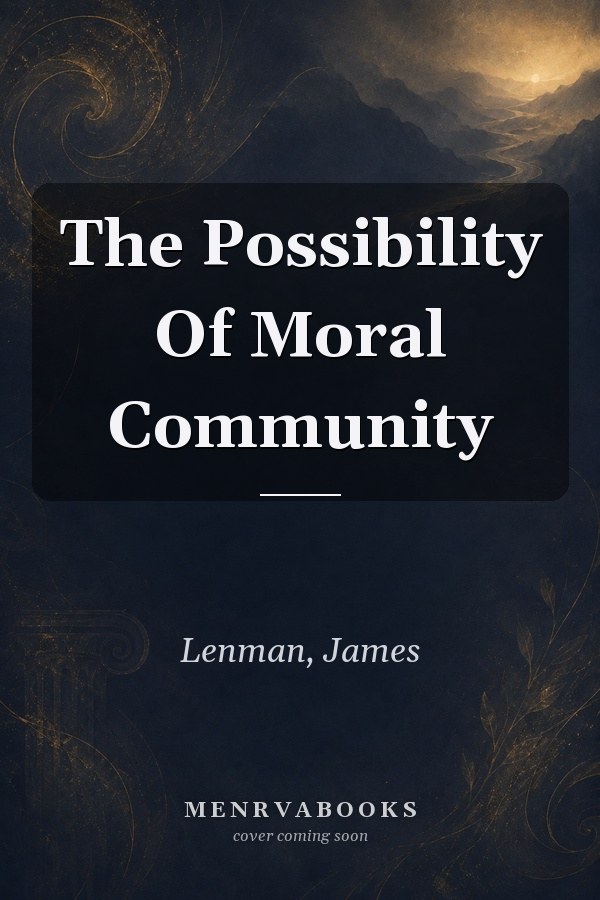
The Possibility Of Moral Community
0
0
As an Amazon Associate and affiliate partner, Menrva Books earns from qualifying purchases. Learn more
Author Description
Cover -- The Possibility Of Moral Community -- Copyright -- Dedication -- Contents -- Acknowledgements -- Epigraph -- 1: Preliminaries -- 1. What This Will Be About -- 2. Real And Ideal -- 2: Our Normative Judgements Are All Wrong -- 3. Global Normative Error Theory: The Very Idea -- 4. Streumer's Unbelievable Errors: Doublethink? -- 5. Central Thoughts About The Normative? -- 6. Supporting The Error Theory -- 3: Reasons And Passions: Holistic Humeanism -- 7. Humeanism About The Normative -- 8. Holistic Humeanism -- 9. The Expressivist Turn -- 10. Quasi-realism 1: Mind Independence 11. Quasi-realism 2: Too Good To Be True? -- 12. Quasi-realism 3: Backgrounding Desire -- 13. The Space Of Reason And What Supports It -- 14. Local And Global: The Whole Damn Thing -- 4: The Politics Of The Self: Conflict, Reason, And The Importance Of Normative Stability -- 15. Conflict -- 16. Reflection -- 17. Stability And Hume's Standard -- 18. Korsgaard On The Unity Of Agency -- 19. The Same Subject Continued -- 5: Towards A Communitarian Expressivism: The Importance Of Normative Commonality -- 20. Heroic Existentialism? -- 21. Reflective Stability: Banking Commitments 22. The Big Important Thing We Share -- A Just So Story: Morality Year Zero -- 23. The Judgements Of Others -- 24. Taylor: Existentialism And Indispensability -- 25. Hurley On Subjectivism And Cognitivism -- 26. Enoch: Indispensability Revisited -- 27. Humeanism About The Normative: Taking Stock -- 6: Our Moral Judgements Are All Wrong -- 28. Moral Scepticism -- 29. What Next? Abolition? -- 30. What Next?: Mackie -- 31. What Next?: Joyce -- 7: Impassioned Interpretations -- 32. Not In Heaven: Walzer On Interpretation And Social Criticism -- 33. Rawls And Reflective Equilibrium 34. The Sorting Problem: Dworkin And Wollstonecraft -- 35. Intuition -- 36. Relativism? -- 37. Fallibility -- 38. Optimism In Metaethics -- 8: Responsibility -- 39. An Old Problem -- 40. Standing For Office -- 41. The Consequence Argument -- 42.
Menrva's Summary
THE THESIS
This book investigates whether a coherent moral community is possible given the challenges posed by normative error theory and the limitations of individualistic moral reasoning. James Lenman, a philosopher specializing in metaethics, draws upon Humean traditions and contemporary debates in normative theory to argue that moral judgments require a foundation in shared social commitments rather than purely objective, mind-independent facts. He constructs a framework of 'communitarian expressivism' to explain how agents can navigate conflict and achieve stability in their moral lives.
THE SCOPE MAP
What You Will Find
- An analysis of global normative error theory and its implications for moral discourse.
- A defense of 'Holistic Humeanism' as a mechanism for understanding reasons and passions.
- Critical evaluations of philosophers including Korsgaard, Taylor, Hurley, Enoch, and Dworkin.
- A proposed model for moral stability based on shared social commitments and reflective equilibrium.
Scope Limits
- The text does not provide a comprehensive guide to applied ethics or specific policy recommendations.
- It does not offer a definitive resolution to the problem of free will, despite addressing the consequence argument in the final chapter.
THE AUTHORITY PERSPECTIVE
Scholars in the field of metaethics recognize this work as a rigorous contribution to the ongoing debate between moral error theorists and expressivists. Readers frequently note the high level of academic density and the sophisticated engagement with contemporary analytic philosophy, making it most suitable for advanced students and professional philosophers.
Page Count:
0
Publication Date:
1900-01-01
Publisher:
Oxford University Press,
ISBN-10:
0191993832
ISBN-13:
9780191993831
Philosophy
Metaethics
Morale
Ethics
Moral Philosophy
Communauté
ethics philosophy
Normative Theory
Communities
Humeanism
Community Tags
Similar Books