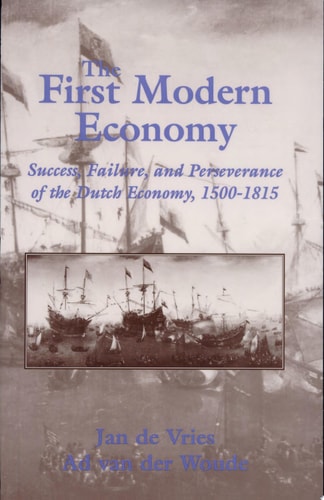
The First Modern Economy: Success, Failure, and Perseverance of the Dutch Economy, 1500-1815
0
0
As an Amazon Associate and affiliate partner, Menrva Books earns from qualifying purchases. Learn more
Author Description
The First Modern Economy provides a comprehensive economic history of the Netherlands during its rise to European economic leadership, the 'Golden Age', and subsequent decline (1500-1815). The authors argue that it was the first modern economy, and defend their position with detailed analyses of its major economic sectors, as well as investigations of social structure and macro-economic performance. Dutch economic history is placed in its European and world context, and inter-continental and colonial trade are discussed fully. Special emphasis is placed on the environmental context of economic growth and later decline, as well as on demographic developments. The authors also argue that the Dutch model of development and stagnation is applicable to currently maturing economies.
Menrva's Summary
THE THESIS
The First Modern Economy investigates the economic trajectory of the Netherlands from 1500 to 1815, a period encompassing its rise to prominence, its 'Golden Age,' and subsequent decline. The authors posit that the Dutch economy was the first of its kind, substantiating this claim through detailed sector analyses, social structure examinations, and macroeconomic performance reviews. The work contextualizes Dutch economic history within broader European and global frameworks, thoroughly discussing inter-continental and colonial trade.
THE SCOPE MAP
- Detailed analyses of major Dutch economic sectors during the period 1500-1815.
- Investigations into the social structure and macroeconomic performance of the Netherlands.
- Contextualization of Dutch economic history within European and world economic trends.
- Full discussion of inter-continental and colonial trade.
- Emphasis on the environmental context influencing economic growth and decline.
- Analysis of demographic developments and their impact on the economy.
- Argument for the applicability of the Dutch model of development and stagnation to currently maturing economies.
THE AUTHORITY PERSPECTIVE
The book is recognized for its comprehensive economic history of the Netherlands, detailing its ascent to economic leadership, its 'Golden Age,' and subsequent decline. The authors' central argument that the Dutch economy was the first modern economy is supported by extensive analyses of its sectors, social structure, and macroeconomic performance. The work places Dutch economic history within a wider European and global context, fully exploring colonial trade and the environmental and demographic factors influencing its trajectory. Its findings are presented as potentially applicable to currently maturing economies.
Page Count:
767
Publication Date:
1997-05-28
Publisher:
Cambridge University Press
ISBN-10:
0521570611
ISBN-13:
9780521570619
History
Non-Fiction
Demographics
Economic History
Environmental History
Trade
European History
Community Tags
Similar Books